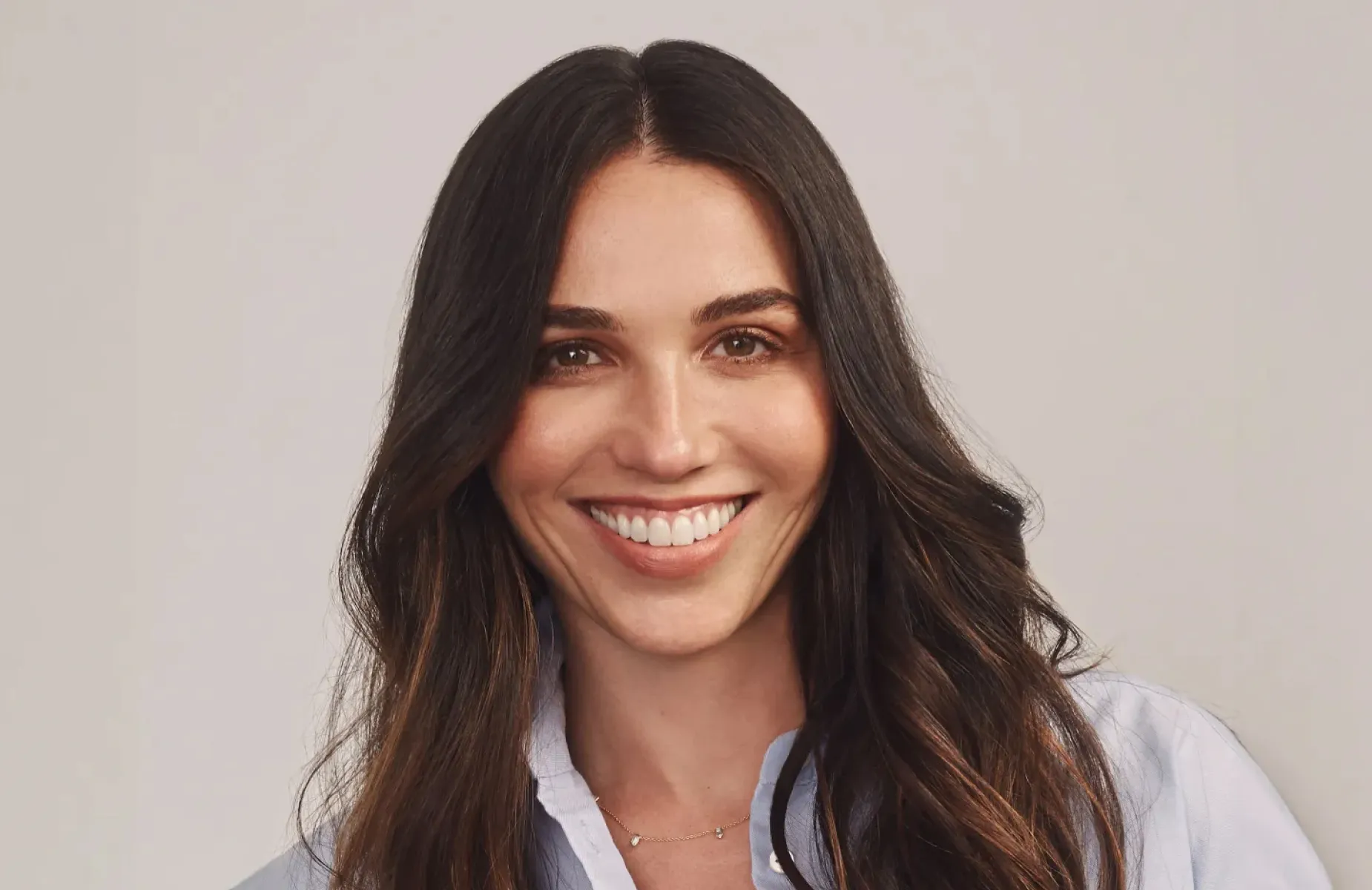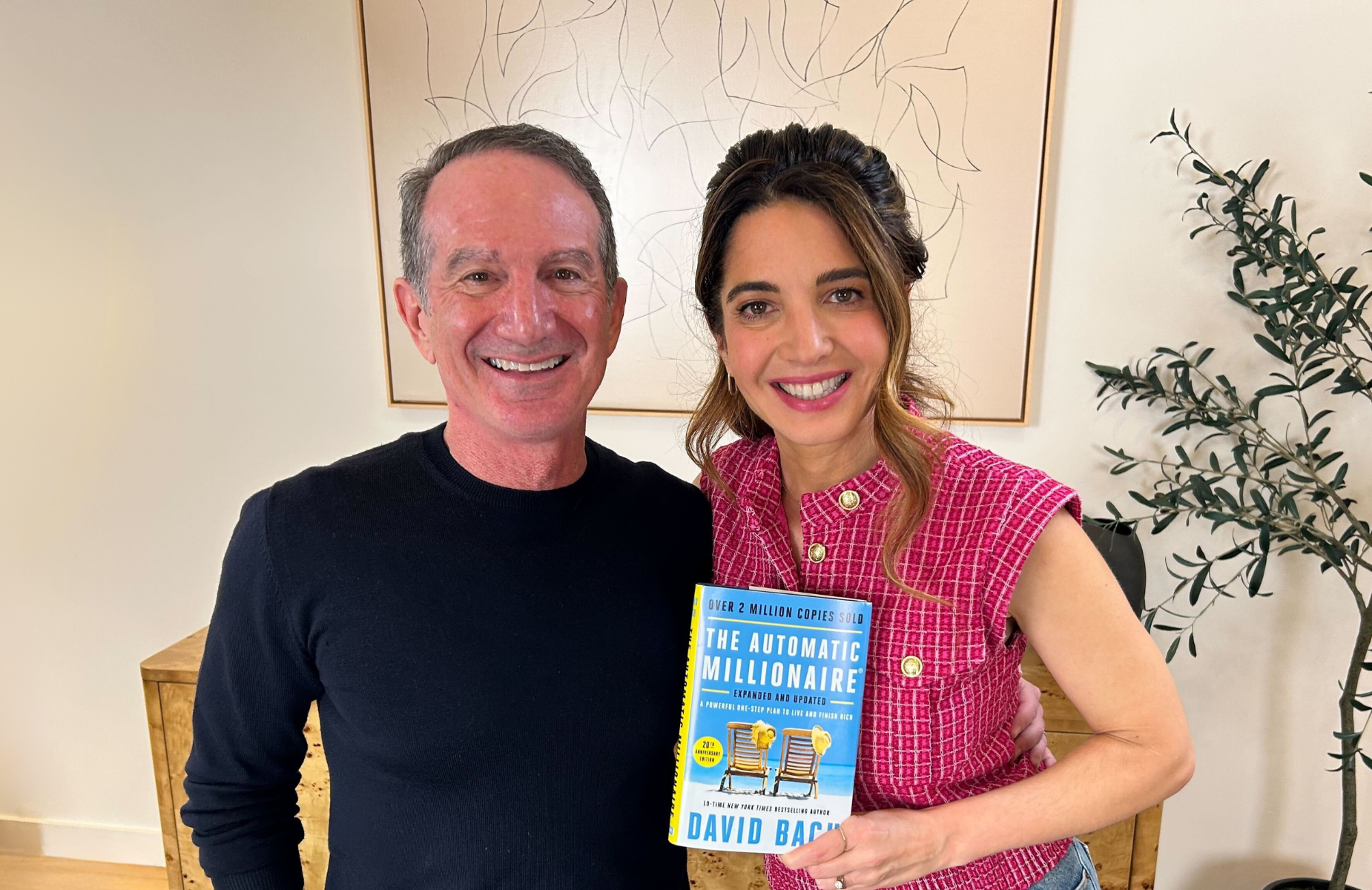
David Bach literally changed my life.
Back in 1999, I picked up his first book Smart Women Finish Rich and I was a complete hot mess with money. I had tons and tons of debt. I was drowning in scarcity. And honestly? I never thought I'd get to a place where I didn't have to worry about money again.
But David's book set me on a path to creating a level of financial freedom I genuinely never thought was possible in my lifetime.
So when David texted me to say he was releasing the 20th Anniversary Edition of The Automatic Millionaire, I was like — YES, let’s do this! Because if anyone needs to hear this message right now, it's all of us navigating this wild, uncertain economic landscape.
In today's MarieTV, David and I dive deep into why he decided to update this classic book for a new generation, what's changed in the last 20 years, and most importantly — the simple, automated system anyone can use to build real wealth.
If you're feeling stressed about money, confused about where to start, or worried about your financial future, this conversation is for you.
Watch now and find out:
- How to set up your finances so you become "automatically rich"
- The truth about owning assets: why stocks and real estate have skyrocketed
- Why 6 out of 10 Americans are living paycheck to paycheck (and how to break free)
- The #1 rule for building wealth: Pay yourself first — automatically
- How automation can work FOR you instead of separating you from your money
One of the most powerful moments in our conversation was when David explained why so many of us feel overwhelmed and stuck when it comes to personal finance.
.jpg)
Listen to this Episode on the Marie Forleo Podcast
Subscribe to The Marie Forleo Podcast


View Transcript
I would say if you're listening to podcasts, it's not a coincidence you came here because there's something that you're looking for involving your money. And if anything we're saying sounds like, I don't know, maybe I should think about this, I don't know. You shouldn't think about this. You should make a decision today. David Bach, this man has made such a difference in my life.
So back, your very first book, Smart Women Finish Rich. I believe it was published in That is when I got it. Wow. And I was, completely. I was just a hot mess with money, like most of us can be, because it's not really something that we're taught in school. And my parents are amazing, but I just still had a lot of scarcity in me.
And I was tons and tons and tons of thousands of dollars in debt. And that book set me on a path. And you know this, but I just wanted to say it out loud to creating a level of financial freedom that I honestly never thought I could achieve in my lifetime. So thank you. I know you've done this for millions and millions of us, but I just had to say that because, I never thought I could get to a point in my life where I never had to worry about money again.
And you were a big piece of my journey, so thank you. It's really beautiful that we're doing this. Thank you. It still touches me every time you tell me I'm still going to high five. Yeah, and because I'm proud of you, I know how far you've come. And you should be proud of yourself. Because what you've accomplished on your own, you did it right.
Like the thing about books and podcasts, they don't do it for you, right? You took the information and then you used it. Yes. And then you shared it too, which is a beautiful thing. Oh, yeah, I love I tell everyone about you and your books, like, I have been doing that for years, and I'll continue to do it.
And that's why when you texted me, you know, again, David and I have become actual, real dear friends. And so we we text often and we'll talk about that as we get later into this conversation. But when you texted me, you said, okay, automatic millionaire th Anniversary Edition, I was like, yes, one more time, one more time, baby.
So, you know, the world is obviously changed a lot in years, and I know that your life has changed a lot. We'll get to that later. But what made you say that? I need to bring this message out again in a fresh way. Well, I'll be really honest with you. There was a selfish reason. And the selfish reason was I have young kids.
I've got a year old who's going to graduate from college this year. I have a year old, and I wanted this book updated for them and their friends and that generation. And so I really felt like I know this is going to be a lot of work. Yeah, but if I can reach my kids and reach my kids friends and reach my my friend's kids, then I can help a lot more people one more time.
Yes. And so I thought, let's do this one more time. This, this, this will at least give ten more years of life to this message, to this book. Yes, it'll reach another generation. And the reality is, things have changed a lot. Yes, you know the world we are living at. Last time this book was updated was which we did a podcast together then.
And I mean, the whole world is different now. It's almost been a decade. AI is changing everything and we are living through a time right now that's really unprecedented. There's there's a lot of fear out there. But, you know, when you go to the good news, there's a lot of opportunity right now. And I think the thing that blows me away when I look at where things have come in years is how much wealth it's been created, because when I updated The Automatic Millionaire and I'm going through all the data, I'm like, God, there's million people now in the US, Marie, who are millionaires.
And contrast that. To contrast that to years ago, there was approximately million. So it's grown by million millionaires in years. It's almost a million millionaires a year. And it's like a hockey stick. The wealth in the United States is skyrocketing and skyrocketing for two out of ten Americans, which talk about that. But it's skyrocketing because everything I taught in The Automatic Millionaire has been proven to be true.
You have to own assets. You have to own stocks, you have to own real estate. Real estate has gone up fourfold in years and the stock market's gone up fold. I happened to be recording this with you today. The market yesterday hit all time highs. And it's also hitting all time highs globally. So we're living in this moment where assets are going up faster, faster faster.
And the same time, six out of ten Americans are living paycheck to paycheck. And there is a separation between the rich and the not rich. And I'm worried right now for a lot of people because automation is changing the game. I call this an automatic economy. And that automatic economy makes you automatically rich if you're set up correctly.
If you have the right system and it keeps you automatically poor if you don't. And the reality is, if you don't have a plan for your money right now, then the greatest technology in the world exists to separate you from your money. And so there is this game of automation that you have to know how to play right now.
Yes. You know, and I'm really happy that we're talking about this because I feel like in this particular moment, so many people and I know folks from across so many industries, obviously the industry of online entrepreneurship and digital media, but then expand that out to actual entertainment. I know contractors, I know builders, I know designers, I know chefs, and you know everyone in all different kinds of verticals.
And so many people are terrified. You know, prices are up, trust is down, and so many people feel lost in the sea of uncertainty. And so I'm so excited that we're talking about this because like you, I'm like, there's a lot of hope. There's still so much that we can do. There's so many simple steps that you can take to take care of yourself and your family now and for decades to come.
And it does not have to be complicated. That's one of the biggest, biggest things. Like, why do you think that when it comes to our personal finance, that so many of us can feel overwhelmed and stuck like a deer in headlights because we're like, I'm not smart enough to handle this.
Marine, the answer's really simple. It's not taught in school. We don't teach people about money in school. Right? If we do, by the way, it's a one day class. So you go all the way through high school, you never learn about investing. Your parents are doing their best. They tell you get good grades so you can get a good job.
Right now they say get good grades so you can go to college. Now we're having to borrow a year for college. So now you're going to college. You don't even know anything about debt. Now you're told to go to college and get good grades so you can do what, get a good job. And then at some point, you're supposed to learn how to do something with that money.
Yeah, you've come out of college, you're in debt, you're living paycheck to paycheck and everything separated, taken from your wealth. You were never taught about money in school. And I can give you examples of this. If you have kids, if you don't teach them how to swim, they drown. It's tragic. And it's true. Like like when you've got a little kid, you start putting them in the pool, learning how to swim at two years old, three years old because you don't want them to drown at their friend's house and they fall in the water if you don't.
If you're not taught how to ride a bike, right? Like I can remember teaching my son how to ride a bike. And in Battery Park City down here, he didn't know how to ride a bike. Yeah, but I had to teach him how to ride a bike. Well, it's the same thing with money. Someone's got to teach you.
Yes, and so it's not taught. And so then it's trial and error. Then people are afraid, and then people make mistakes, then they feel stupid, then they get paralyzed. Then they beat themselves up for what they've done wrong. You. It's not your fault. The system was set up for you to be trapped financially. Yes, that's the truth. Yep.
And it almost makes me mad that the automatic millier book was needed. Like when I launched this book on Oprah at the end of the show, Oprah turned to me and she's like, they should teach this stuff in school. And I'm like, I know they should. Yeah, because I said, honestly, I'm not teaching anything that you should have been able to get a high school and not.
No, totally. And yet, I mean, people who are in their s, in their s, in their s, it's like, I never heard of this stuff. Yeah, completely. And there's so much emotion wrapped in it, too. I think that for most of us, I know, myself included. You know, growing up financially, it's like my dad worked really hard and nonstop.
And my mom, who grew up in a really abusive environment as a child, she just there was so much scarcity. There's so much not enoughness. And again, it almost doesn't matter what's in your bank account, because I know even in current times, people that are earning well over six figures are still living paycheck to paycheck each. So it's almost like we can almost set aside how much you have the emotional scarcity, the fights about money.
My parents got divorced over money. It's like that whole emotional layer gets a lot of us also, besides even the, you know, just brass tacks of what to do with your money. It's like there's a lot that keeps us in a state of feeling afraid and feeling shameful and feeling also, I think in this world with young people, you're seeing social media, you're seeing reality TV, you're seeing all these like displays of extreme wealth and like, wait, I want that.
I shouldn't want that. So there's a lot going on. I deserve that, yes. Right. Yes yes yes yes yes. So for anyone watching right now who's like, oh my God, this sounds amazing. If they're feeling hopeless about money, do you believe now in and beyond, it is still possible for anyone to live rich and finish rich %?
I wouldn't be here if I didn't believe that. Here's what I really believe. Marie, I think the next ten years is going to be the greatest decade to build wealth of our lifetime. I love that for those who are set up with a system, right? Like I say with this book on Mac Miller, on the back of it says wealth is not a secret.
It's a system. Yes. And and that's the truth, right? There are no secrets anymore. Yeah. It's about. That's a good thing. It's a good thing. It's about the system. But I think these next ten years, it's almost I think we're the beginning of a hockey stick, like even though we've had like the last five years have just been insane, right?
Yeah. Like, if you've been in an index fund and I give all kinds of examples in on Mac Miller, like, let's just say you were in the Vanguard Total stock market fund, okay. Just a boring generic, the greatest boring generic mutual fund that's probably ever existed. stocks in it last five years is average over %, and it's average over years, well over % annually.
It's just a boring it's just a boring index fund. Right? Right. So the question people are like, well, now that has gone up so much, did I miss it? And the answer is no, you didn't miss it. You didn't miss it. I mean the market's pullback. That's what happens. They recover. But what Anna is doing is transforming the world.
And it's going to take a lot of jobs away. It's also creating profitability for companies like we're probably never ever going to see again. Like there's going to be there's a moment in time right now where businesses are about to get extremely profitable. Yep. Now that will hurt some other people. But I'm telling you, every single day you're going out and spending money on everything, right?
Yep. Everywhere you go, you're spending money. Yep. You have to be an owner in those companies. You have to own stocks in the stock market. And we can talk about how you do it today to make it simple and easy for you. Oh, you have that all laid out in the book not to interrupt you, but I also I want to restate this because I can I have developed the gift over years of hearing my audience, even while I'm recording things, is you do not have to have a lot of money.
You do not need to earn a lot of money in order to set up smart systems and build wealth over time. Just to be clear, I think and thank you for hearing your audience in your head, because what I would tell you is that today you can save your change automatically. You know, when I started doing this years ago, the first original copy, The Automatic Millionaire, I had to list mutual funds that would take $a month.
You know, I had to find the funds and could take that small amount of money. And the paperwork to set up an automatic investment plan was six pages. Yes. And if you came into my office to do it, Morgan Stanley took us minutes, and then it took three weeks after we gave the the voided check and you filled out six pieces of paper.
It took about three weeks to automatically debit your account. Today you open your phone and I'm just give example, you use a company like acorns okay. Acorns is an app that you can save money automatically into a diversified portfolio of indexes, basically. So low cost you can round your change up so anyone's like, I have no money, great round your change up when you go shopping and you buy anything, the change can be rolled up into an investment account and you can set up an account on an app like that in ten minutes or less.
So literally, someone could get done watching this podcast and just go, wait a minute, what? And go to an app? And I'm just giving that as an example. And you could be investing in automating your pay yourself first account, which we're gonna talk about. You could be automating your emergency account, which we're gonna talk about. You could be automating your dream account.
And if you don't want to use a company like acorns I go through, you could use Schwab, you could use Vanguard, you could use fidelity. You could use Coinbase, you can use Robinhood. There's no limit to how many companies are available now to help anyone get started automatically, easily. Now. Yes. And this is the best thing ever. So before we start to get into the tactics and how easy it really is, especially in today's age to do this, I want to start with a counterintuitive step to getting great with money, because a lot of people, especially when something is, is intimidating or can be as intimidating as money conversations, it's like, okay, tell me what
to do, how much. You know, you start getting into the brass tacks, but I want to talk about something that is important to both of us. You say this and you say your values can determine how hard you're willing to work to achieve your financial goals, how much money you currently spend, and how much money you will actually need if you want to move towards retirement.
So talk to us about why it's important in any money conversation to start with our values, and how do we start to think through this? I spent almost a decade as a financial planner. Most financial planners start with the numbers I never did. I started by asking my clients what was most important to them. It's because they're expecting me to tell them how their money's going.
I'm like, wait a minute, we got to step back. What's most important to you right now? Let's talk about your values. What do you care the most about? Let's design the rest of your life around your values. Let's look and see if the way you spend money aligns with your values or conflicts with your values. Let's look and see if the way you're saving for the future helps you get closer to your values, or takes you further away from your values.
Once you retire. I mean, once you retire, you have all this time on your hands. Your values should be coming instantly. They should be clear before you retire. Yeah, but the moment you retire, that's when you get to start really living your values. Now, I want people live their values before they retire. Yeah. So what I tell people, as you know, this is not complicated.
You take out a big yellow pad of paper and you write down what's most important to you, what's really most important to you, which is family, friends. I mean, I'm giving you examples family, friend, health, security, freedom. And in previous books like Smart Women Finish Rich and Smart Couples Finish Rich, I walk you through what I call values based exercise and based on purpose focused financial planning.
Writing out your values, looking at what matters the most. If you're in a relationship or you're married, talking about your values together, then turning to the money and the reason is when your values are clear, your financial decisions become easy. Yes, and that's the key, because what holds people from making change is decisions. Yeah, decisions are what change everything.
Like at some point you read smart women finish Rich and you made a decision to make changes in your life. Yes, everyone who writes to me with success stories, it's something happened. They made a decision, right? The difference between people who do and don't is simply a decision. When your values are clear, when you're clear on your values, you're almost like a magnet pulled towards your decisions.
Absolutely no. You need to make them. I also feel like, one thing that has been really true for me for my entire career, most of my life, and I'm constantly revisiting this sometimes. And by the way, y'all, you guys know me. I live in New York City. At times in my life, I've lived in New York City, in California, like two of the most expensive places.
And I'm very cognizant of that fact. You know, like my accountant, I was like, really? And I'm like, yep, like, that's just me. But my point is, is that even living in two very expensive locations for, part of my life and now just mainly in New York, I've always been someone who knows, like, I don't really need to spend a lot in order to enjoy my life.
Like I live quite simply. Yeah. I love cooking meals at home. I love doing really simple things that don't really cost much. I'm not really much of a close kind of person, you know, there's all these things, and I think that when you're able to get clear on your values and what really means the most to you, sometimes you can discover you need less than you think.
Like, well, I mean, the ironically, first of all, %. The most ironic thing about actually reaching a point where you're totally financially free and you have a lot of money. Yes. And this I think this is true for most people is once you're there, you realize you don't want anything. But like like where I am in my life, I don't, I don't there's nothing I want to acquire.
All I want are experiences. Yes, I want the time to enjoy those experiences with my friends and family. Yeah, I want my health. Yeah. I want the people I love to stay healthy. Right. My mom's still alive. My dad passed away last year. Like, I want to get as much time as possible with the people that I love.
Yes. And I don't care about stuff anymore. Yes. And it's just ironic because when I didn't have the money, I wanted all the stuff. All the stuff. I think that's part of our human journey that we go to. And you think like, oh, if I could just have this, like, if I could just have that. But I think tying it back to the values conversation, oh wait.
I also want to just tell you one more thing. Yeah. Because having worked with retirees now for years, the interesting phenomenon and this is true, like when you work with people who retire, when you work with people have money. We spend really like from to accumulating not just money but stuff. Then we start accumulating stuff in our s, s and s, a lot of times people don't start to accumulate until they're in their s.
The sooner you accumulate that, the sooner you get ready is. It's just ironic. The sooner you get rid of your stuff. As you get older, the easier life becomes. I'll tell you, I have been, you know, when you and I have been texting for years now, I think it's been like or years. I've had this inner sense for myself of just needing and wanting to shed.
And my friends, they they all laugh at me. Josh laughs at me too. It's like nothing makes me happier than a good purge party, you know what I mean? Like, if I'm going through my drawers and again, I don't have a lot of stuff like my friends like, what the hell are you getting rid of? Like, you're so minimal.
I'm like, there's more to go. Because this feeling of freedom and spaciousness in this feeling of like and really for myself, not judging anyone else, but it just has become clearer and clearer. Similarly, what I value most is freedom experiences, creativity. So it's like being able to, quote unquote, invest in my dance classes or art or travel or again, making meals or hosting people.
You know, all of which, again, it doesn't have to be, you know, champagne wishes and caviar dreams. I don't even give a shit about that stuff completely. But it's like I'm noticing as the years kind of just just continue to roll forward. It's like, wow, I'm enjoying less and less and less. And I think that that's it's really important for all of us.
So I know a lot of people watching right now. You know, some of you are going to be in that beginning stage of life where you're either in college or starting, you know, to get out on your own. Like my stepson, him and his husband, you know, they're right at that ish mark. And I've been man, I've been shoving David Bach books in front of them like, since he was nine.
Like my stepmom, because my stepson is an actor. And I remember he got this big role on a movie. It was with Nicole Kidman. It was the first time. And, you know, so he was like a teenager even below, like pre teen when he first got this role. And you better believe that mama Marie pulled out the whole chart from Automatic Millionaire showing, like, do you know what I mean?
If you save this and you're only or look at what's going to happen by the time you're Well, you know, it's actually insane. And the last time I was with you, we did my book, The Latte Factory. Yeah, yeah. And it's the only book that my kids have. Actually, they read that book because that book was super short and they could read it.
And so both my kids are like, well, I want one of these Roth IRAs. And the charts in the book started at And James is like, dad, do I have to wait until I'm ? So I said, well, no, actually you don't. We can start one for you at So I ran the numbers for James, actually yesterday, ironically.
So James is So he's we funded a Roth IRA for him, put him on basically the payroll as a business. Right. And and funded his Roth IRA and he has $at the age of now in his Roth IRA. Now, here's the incredible math on this, Marie. If he saves $a day. So just basically keeps funding the Roth IRA, it's $a year.
It's going to actually go up, right, because it'll increase the amount you can put in. But if all he does from now until he gets into his s is save $a day, this kid's going to have over $million in his IRA account, tax free in his s, and that's $a day in people. Where's he going to get $that?
Please trust me, you you can these teenagers can make $a day and it's going to help in the beginning. Yeah. But what I'm really doing by talking about this and teaching him is I'm teaching him how to fish, right? Like I'm fishing. First I'm putting the cat, I'm putting the, like the little rod in the water, and I'm catching the fish and I bring it in, but eventually I'm handing him the rod.
Right. It's like this goes back to teaching your kids. Yeah. So. And when I walk around with him in Florence, I go, you know, we play this game. I'm like, okay, so tell me the difference between a Roth IRA and deductible IRA. Right. Okay. A Roth IRA goes in after tax. It comes out. You know I get it tax free.
Okay. Tell me about the deductible, IRA. So that by the time this kid leaves for, you know, college, he knows the difference between index funds and actively managed funds. He knows that he should have a Roth IRA or deductible IRA because dad has just talked about this all the time. Yes. And, you know, this is I know this sounds complicated, but you read a book like The Automatic Millionaire, you can teach this to your kids and so many parents have, because the number one thing people who are older say to me is, I just wish I had started when I was younger.
Absolutely. That's what most of us say about many, many things. So by the way, for all of you listening, like I reread this prepping for our conversation today, here's what I love about your work. First of all, it's so encouraging. It is very straightforward and simple and it's super, super, super actionable. Thank you. Like you're such an encourager.
And as an I like blew through this. You know what I mean. As and it's just like so if you're thinking about this and you hear anything that David's talking about with these different things, it's so clear, it's so simple, anyone can do this. And it would be quite fun if you've got anyone in your life, even if they're not, teenage, you know, age kids, they can be in their s, they can be in their s.
You might have nieces or nephews, you might have other people in your life who are just going like, dude, I need to figure out my money life. It's like, let's do it together. So I want to talk about one of the biggest mistakes we all make with money. And fixing this really is the secret. Let's talk about automation.
I mean, it's in the title The Automatic Millionaire, and I feel like it really is at the heart of this book, this work, this system that can help people create financial freedom. And they don't need discipline, they don't need willpower, they don't need to earn a ton of cash, and they don't need to take a good jillion months or years to figure this out.
Yeah. Well, so first of all, why why do you need automation? Because all the other stuff doesn't work. So what doesn't work? Budgeting doesn't work. Why doesn't budgeting work? Because budgeting is a pain in the ass. If you've ever tried to budget, I'm going to put this much money away for food, and I'll put this much money away for coffee.
And this is how much money is for my nails. Whatever your categories are, people will try and budget for a month or two. Most chances are married to somebody who doesn't want to budget. They fight over it all the time. Budgeting fights over budgeting can lead actually to divorce. You know, I wrote a book, Smart Couples Finish Rich the number one cause of divorce is fighting over money, so budgeting does not work.
The other thing is discipline doesn't work. I'm going explain that. What do I mean by saying discipline doesn't work? You're too busy to do these things over and over again. I was at Morgan Stanley nine years. I only had one client bring checks to me for more than six months to save and invest. Everybody else who saved, they saved automatically.
And that's that's why I just came from a place where I was a company that just opened up AK plan, all right. And I said, you know what's scary? The single most important financial decision most people make is the day they have that meeting. You know, they bring a pizza, they bring all the employees, and they go, great news.
We have AK plan. The guy comes up. In this case it was a fidelity company. It was fidelity. And they do that presentation for minutes. People are on their phones or eating their pizza. They're talking to their friends are not totally paying attention. Half the time. They're not realizing that one meeting where I sign up for my K plan, that one decision where I automate my financial life is the actual, most important financial decision we make in my entire life.
And that one decision determines your financial future. And what is tragic is most people don't pay attention, and they often now do what is called accepting the opt in rate and the opt in rate. This has changed. It used to be you had to opt into your four on K plan with the secure act. This is like a part of the update.
The new Secure act is requiring most K plans, depending on the size of the company, to opt an employee in at a % savings rate. Now a % savings rate. In technical terms, what that means is you're not saving enough money. Absolutely. And it means that you're saving less than minutes a day of your income. So how much should a person who signs up for AK plan at work use?
You need to be saving at least one hour D of your income. Now, one hour a day of your income is %. If you want to really make this a no brainer, you save at least % of your gross income in that K plan. Why is it %? Because we have all the data now. We know when we look at who became automatic millionaires in K plans, we know what they save.
And it's actually Fidelity's data. They save % and they became a millionaire in years. And they had that million dollars down at age And the mixture of their investments was % stocks and % bonds. Most cases they used a target dated mutual fund. That is, by the way, what you should use. I talk about all of this in The Automatic Millionaire.
So you should be maxing out, you know, minimum one hour to save your income in your k plan, you should be using a target date and mutual fund based on when you think you're going to retire. So I think I'm going to retire in years. That target date in mutual fund is going to have a due date.
It's can say, what's years from now? It's going to say By the way, you think that's a long way away and you're going to go and you're going to go like this. And years will have gone by. Yes. And so that's the most important thing you do. Now. The tragic thing is that some people do things actually right.
They max they put this percentage in there for one K plan, but they don't make the second decision, which is you have to choose the investment, because if you don't, it goes into a money market account or savings account and earns nothing can earn %. There are people listening right now to me, I promise you, who have K plans IRA accounts.
They think they're doing everything right and their money is invested in nothing. And I meet these people every day and they go, what's he talking about? They will. People will come up to me, Marie, and be like, I read your book. I opened up my IRA account just like you told me, David. And it's a great. I always ask questions.
Great. Where is it? It's at Vanguard. Fabulous. What's it invested in? What's in the Vanguard, IRA? Great. What's it invested in? What do you mean? Come on. Did you read the whole book? Like it's got to be in a mutual fund. It's got to be an investment. I've had people open up their phone, go online and look at it like it's in a money market.
Can't go fix that right now. So a couple other things I'll share because like to get the real nuggets in here, people are not all staying in jobs for years. Absolutely. They're leaving jobs. Then these are the things that they do that destroy their life to do not cash out your foreign K plan to pay taxes and penalties.
Don't do that. Then you also lose all the growth. Second thing is don't leave the money. In my opinion, at the foreign K company rolled into an IRA account in your name or move it to your next foreign K plan. Here's where the next mistake comes. People do everything right if they work their way up. Not everybody goes from zero to saving % or %.
A lot of people start at three and then they move it to six, which is great. Then a year later they move it to nine, right? They move. They like like like training for a marathon. A lot of people just slowly increase, which by the way, if you slowly increase, if you started at %, you would never notice the money coming out of your paycheck.
If you changed it % a month for one year, you'd be at %. You'd be in great shape. However, some people do this. They change jobs. They move their money from one form K plan over to the next. But the new foreign K plan then opts them back in at %. Oh gosh. And Vanguard just came out with a report saying that that one thing is costing many retirees now $in retirement.
So you know what? All of this can be made automatic. What I've realized in the last years. And this is why I think people are also like buying, going to buy, buy. They update and keep hearing about this is everything's not always automatic for years. If you change jobs, you've got to reanimate it. Absolutely. And reexamine the detail and reexamine the detail.
That's right. If you haven't. You know, I talk about, paying your home off yearly like a biweekly mortgage. Well, people tend to refinance mortgages every to years or move. So then you got to automate the mortgage again. Yes. So automation is great. I say, you know, do it once you're done, set it and forget it.
And that's mostly true unless things change. Yeah. Then you have to automate again. Yes. No, it's it's really, really important. I love it because you already answered one of my questions was what are some of the biggest mistakes people make when they try to automate their money, which is not paying, in my opinion, close enough attention to the details to make sure that they are really set up and you know it.
It can feel like you had a victory, you know what I mean? If you're like, oh my God, I enrolled in this thing, or I'm doing the most that I possibly can. But I think in today's world it's so important more than ever to really triple check yourself. Like I just am reflecting on life in general, how much more complicated it's become, how many more inputs we have coming at us on a daily basis from so many different social platforms and so many different ways that people can reach you.
And I'm just watching in different projects outside of the realm of straight up personal finances, where details get lost because so many of us are so flooded. So I just want people to hear this right now. It's like setting it up. It is set it up and check it just and let me give an example to you said two things I really want to I want to make sure we hit them because they're so important.
When you automate your financial life, you actually feel better instantly. So someone who watches this podcast listens to us and then says, you know what? He's right. I'm going to pay myself first. I'm going to go open up an account, at least save something, whatever it is, $a month, $dollars a month. The moment you do that, you feel better.
I can't overemphasize how valuable that is, because it's beyond giving yourself a pat on the back and having green juice. Okay? It's like you really feel better. People take all these vitamins. This will make you feel better than the vitamins you'll feel instantly better. Second thing is, can I just gimme your phone for one second? Yeah, I'm gonna use your phone as a prop here for those.
You're watching us. So these phones today make you automatically rich or make you automatically poor? I said that earlier because we're on these phones all day long. People click on things and decide to buy things. And many of what we click on Inside to buy is actually designed to have us try it out for free for days.
And we tell ourselves, well, I'm going to use it. If I don't use it, I'm going to cancel it and we don't. And people have hundreds of dollars a month in subscription fees for things they don't use. Absolutely. So one of the things I would tell you to help you find money, go through your credit cards, download stuff into an app that can show you everybody you're paying monthly examples like a company like monarch does this, or Y and B, these are apps that you can use, track all your money, or just go to your credit card companies and go through the list.
Who am I paying automatically? And then I would tell you this unless it's like life urgent, I would shut it off. Because first of all, when you shut everything off, they will start giving you better, better deals. So almost anything you shut off, they've automated to try to keep you as a customer. Everybody wants the lifetime value of a customer.
Nobody wants to sell you something monthly for one month. And they know, based on their business model, that most people take some to months to shut something off. And what's fascinating about this is how much crap we buy that we don't use, that we're paying for automatically, and we stop thinking about it. When you buy something that's $a month, that's not just $a month.
It's not just a dollar a day. That's $for the year. That's for the decade. There are people who are still paying for services from ten, years ago that they never use. When my dad died, we had to do all this, you know, help my mom. And one of the things I'm like, mom, I'm going through the cable bill.
I'm like, there's five cable boxes in this house on your bill. Where are these cable? Do you use cable boxes anymore? Because everything's plugged into the back of the television set. You're watching Apple TV. She's like, I don't know. They're just sitting underneath all the television. They had been paying for cable boxes for God knows how long. But like all just the stuff and I will say this, I know I'm on different tangents here, but like, if you ever buy something that you're going to pay for monthly do and you use Apple, do it inside Apple, use the Apple Pay process.
And the reason is Apple's the easiest way to shut everything off. Right. Because I can open up an Apple. Everybody I'm paying monthly and I can go click click click click click is done. Yep. When you pay the company directly they make it hard for you to figure out how to turn these things off. Oh they almost make it impossible.
I mean you're talking about when your dad passed, which I'm so sorry about, like when and, you know, I've been going through quite a lot with my phone, you know, trying to cancel their cable box in Xfinity. You can go yourself. I have never lost it on a line more than with this company. They were like, is he dead?
I'm like, my dad has dementia and they will not let me cancel. You know, they're like, well, he needs to show up. I'm like, good luck with that. Anyway, just, that was it. It's so out. It is so outrageous. I have never like Jersey Murray comes you know Jersey Murray. She comes out. I have not seen her come out like this.
I was like, oh, Xfinity, you want me to show up on your doorstep? I mean, I gave them not even up. And then they want you to bring the box back, which is going to throw the box away anyway because it's ten years old. Just to make that point, though, I think it it is it's so it it's so incredibly important.
I want to talk about folks who might be watching or listening right now, and they're like, this all sounds good, but I'll start saving when I make more. What would you say to someone who feels like they're so already behind or barely getting by? And that is their truth. Obviously we can go through the subscriptions like that's one place, but even if they just needed a shift in their mindset, yeah, they just needed some encouragement.
Outside of a tactic, how would you address that person? Here's what I would say. And I you know, back in the day, I used to do a lot of speeches and I would say on stage, let me ask you all question. Let's just be honest with each other for a second. If you go back in the office tomorrow and your boss sits you down and says, David, you're amazing.
We love working with you. You've added so much value. This company, and we want you to be with us for years. But we're going through a difficult time right now and we're really sorry to say this, but we definitely don't want to let you go. But we're going to need to cut back your pay by %. It won't be permanent, but we're going to we're going to have to cut you back by %.
Would you keep would you stay with the job or would you walk out the door? And when you when you see that in the live room of people, it's fascinating because you watch them think about this. Right. And and when they're when you talk about it, what most people will say is, I wouldn't walk out the door. I need the job.
Right, right. I can't, I have maybe I'll go look for another job. Sure. But I'm not leaving this job. I need the money. I need the money. Yeah. So how will you survive? By giving yourself a % pay cut. You didn't to give it to yourself. Somebody else gave it to you and you. When everybody says I'll figure it out.
Yes. Wait, wait. There's a book here. Oh. Everything's degradable. This is literally what people say. They go off, figure it out. Yes. So what I would say to someone, it gives me chills saying this because it's so true is like, figure it out. Yeah, figure it out. It's so much easier. Figure out the younger you are. Yes. It's so much easier to figure out today.
Today, while you're sitting here, you have you're hopefully healthy. You have energy. You see a future in front of you. That's the time to figure it out. Yeah. You know, I always say in our s we hear about money. In our s, we start to worry about it. In our s, we start to get super nervous. In our s, we hyperventilate.
Yeah, right. And so every decade gets harder. And wherever you are today, today is your day to start. Yeah, I would say if you're listening to a podcast, it's not a coincidence you came here because there's something that you're looking for involving your money. And if anything we're saying sounds like, I don't know, maybe I should think about this.
I don't know, you shouldn't think about this. You should make a decision today. Let's make some decision. Whatever that decision is, make something. Also, you have to get leverage over yourself. In The Automatic Millionaire, I talked about the fact that people will work hours over their lifetime. Some people more. So if you're a double income household, you're looking at $maybe $
You know, it sucks. Get to your s and s and having had spent all those hours of your life making money and you didn't keep any now, you didn't keep any because, again, the system was set up for you to not keep it. Who gets paid first? The IRS, they take the first three hours day of your income to taxes.
Then you start to pay everybody else automatically. The whole key to building wealth is that you become selfish and you say, no, no, no, no. Done. I'm paying myself first. Me, David. I'm paying myself first. Me money. I'm paying myself first. Every time you earn a dollar, you pay yourself first. The first person who gets paid. Who is it?
It's you. I could sit this for the rest of my life. It just turns out this is the. This is the end of my show. So literally, pay yourself first. People should put this on their, you know, tattoo it. Tattoo it. Like, pay yourself first. Pay yourself first. Money comes in. Money should not just go out. And the problem is, if you believe that you have to make more money to save, you will never get around to saving.
I mean, I know I believe this, by the way. I'm sitting here like on the pro, but the reality is, I mean, all kinds of mistakes. When I was young, when I was young, I was living paycheck to paycheck. I had credit card debt. I did all the stupid shit you're not supposed to do. Then I made $a year, which was a lot of money out of college, and I spent more than that.
And then I made I spent more than that. Then I made I spent more than that. I was on that rat race of make more, spend more until I met the mcintyres that the Automatic Miller book is based on. And when I met this couple that came into my office earning half of what I earned, able to retire in their early s, that was the moment that changed my life.
So speaking of stories and speaking of the mcintyres and what's possible, the other thing I love about this new version is there are so many stories from people, from all walks of life and who have used this system to create their version of financial freedom and to get themselves out of that terrible, sinking place of despair where they feel like they're going to be working their whole lives until they drop.
So out of all this, the stories that have come in and I know even a new one came in that I'll read in a moment, was there one that's in the book that made you just say, this is why, this is why I'm back here again doing this? Well, yes. There's a couple in here. And it's interesting how this all works for me, because I actually think none of this was me doing this was all God doing.
God gave me this message. God. So, you know, I felt like I was put here to do this. This is my purpose in life was to free people financially, actually, so that they could then listen and use their God given talents. That's why I think I did this work, and there have been a lot of points in my life where I wanted to quit, and there was a point where I'm updating this book where I was so fricking frustrated because updating these books is actually so hard.
And I was sitting there working at my desk, doing the old school stuff that we do, updating the manuscript. And I get I was in the process of needing to get testimonials. And you know what a nightmare this is. Absolutely. As authors, we hate getting testimonials. And I'm like, I need some new testimonials. So people I don't know yet.
So I reached out to Tiffany LHC, the budget sister. I didn't know Tiffany. I knew of Tiffany, but I didn't know her personally. And so I sent her a message and I said, hey Tiffany, I don't know if there's any way you would consider doing this book. Could I send you The Automatic Millionaire and would you be willing to maybe give me a testimonial?
And Tiffany messaged me back and she says, yes, I'll give you a testimonial, but I'm going to give you more than that. And so she sends me this audio file, and she records like a seven minute audio file, and she tells me how the automatic mill in her book totally changed her life. And she walks me all the way through it.
She's like, I was a school teacher making $a year. I was living at home. She'd been a teacher. She'd even lost her job. She was with her mom. She was what? They watched the Automatic millionaire show, the Oprah. And she's, like, super depressed because she's huge and huge credit card debt. And she's like, I went down to the bookstore because everything you said on that show made sense to me.
And I'm like, I think I can do this. She went down to the bookstore. This is her telling me the story and audio. She's like, I got the book, started reading it. She's like, I'm a teacher. So I'm a student. She's like, I'm like, I can do this. She's like, I can do this. And then she's like, she starts doing it, getting herself out of debt.
She's like, not only can I do this, but David, I think I can teach this too. She's like, you know, I'm a teacher. And she's like, the way you taught me. You weren't condescending. You brought me up. That's how I teach. She's like, if I can get myself out of debt, I can go teach other people like me how to do it.
And she did. And she's now a multimillionaire. years later, she's a multimillionaire. She's like, David and I have an eight figure business, and I've taught millions of people. I was like sitting in my kitchen and listening to this story on her, on my phone, and I actually started crying in the kitchen because I was just like, okay, God, I got it, I got it.
So that story really touched me, and you know, I sent you a story today that someone sent me, and I read it on the car ride down here. These stories that people send me have been the fuel that's kept me doing this work. Yeah. And I love you saying that, too, because sometimes I think people see someone like you.
This is books, then, right? This is your th and you've had it just. It's insane the career that you have. It's so beautiful. And some people are like, oh, it must be so easy. It's like, no, dude, it's hard. It's hard to keep it going. And I just really appreciate you for saying, like, there's been so many times and you're like, oh, I'm done.
And it is the stories that pull you back. I want to quickly read this one that you texted me as we were, about to film. And this one is from Joe who says, hi, David, I just wanted to reach out and say thanks so much for your books, the impact they had on my life. I'm very grateful for you and sharing your knowledge in such an attainable way.
I was a bit of a nerd as a kid, frequently walking out of the library years old with or financial books to consume. Most gave good advice, but I always struggled knowing how to put them into practice. When I discovered smart couples finish rich and the automatic Millionaire, it was like the light bulb clicked on in my head.
I've been investing on a regular basis ever since. I've never had a super high paying job, but at I was able to pay off my house last year, and now only about to years from being able to retire fully should I choose to. Plus, I've had an amazing life of travel along the way. I can't imagine how different things might be if I'd never read your book.
Thank you for your very practical and helpful advice. And that makes me almost cry too, because it's like, you know, you don't have to have a good jillion dollars salary or necessarily, you know, obviously I'm an entrepreneur, and that's something I've championed for a very long time for a lot of people. But there's not one way to do this.
There are many, many, many different ways. And it doesn't require like having financial freedom doesn't mean that you have to be a good Jillian there. You know what I mean? In order to have this beautiful life where money is not a constant source of stress and worry all men. And also you don't need a college degree. Yeah, right.
Like this kid started reading these books because he he went to the library. Yes. And started reading them at and Yes. And it's amazing to think that this kid's paid his house off at and can retire. He's talking about retiring by the age of Yeah. There are a lot of people, listeners going, man, I wish I'd started earlier, so I'll just start now.
Yeah. You know, I'm sitting with this huge stack of cash in front of me. And for those of you who are listening, yes, you can't see the stack of cash. But for those of you are watching Mackenzie, is this in the shot? Can you see the money in the shot? Can I just tell you guys there's like, nothing no guest on Marie TV has ever come in and just given, like, just put, like, a stack of cash on the table.
And I was like, I like this. Can we have more of this, please? You guys know how much I love money, but please, let's go back to it. I'm like, this makes it very happy. So I'm not one of those people who shows off money in Lamborghinis at all. But this cash is. So this is actually you're going to know what this is.
But guess what this is. If you didn't know how much money you think I'm holding, I honestly don't know. If I would know. I'd probably say or It's Okay. Why did I bring as a as an example, as a prop to show everybody? Because the most viral post to ever put online is what does it take to blow $a year?
And the answer is it's $. So so let that day a day okay. So let that sit for a second. What does it take to blow $a year. It's $. Now we're sitting here in New York. I'm at a hotel where the cocktails are $plus a tip. It makes me want to punch people because it's like, I mean, everything is so expensive, but I promise you that there are a lot of people listening who are not saving any money.
They're not saving $a year. Yes. And they're blowing $a day. So if you started with, how could I take $a day, not blow it up and invest it instead? You could be a multimillionaire. And in the end, I'm actually I show the math on this now in the latte factor chapter, I'm like, you know, $a day done for years invested.
You have over $million. If you're invested in the stock market and you earn over %, % actually is the number we used. And you can go run your own calculations. People like, I don't know if I can get %. Yeah, fine. Whatever. Don't run your own calculation. Go to investor.gov. I give you the website, but it starts with the money.
And here's what I have hundreds here on top. And I think this is really important to show people I like this hundreds by the way I like these hundreds okay. So I'm holding $Yes. So % of Americans, almost four out of ten, can't get their hands on $in case of an emergency. Now, if I add to this and I go five, six, seven, eight, nine, ten and I hold $six out of ten Americans, according to according to different research, will tell you that the six out of ten Americans can't get their hands on $in case of emergency purposes.
So we got to fix these things. Yes. And no one's coming to fix this for you. You know, people, I say no one's coming to save you. But I think that people think someone's coming to save them. When it comes to money, I think we think presents will come save us and governments will come save us. And someone's coming to save us.
No one's coming to save us, okay? Things are actually when it comes to anybody saving. It's going to get worse. Social security is predicted and told to us. Now, these are not like random rumors. Social security is insolvent in That, my friends, is around the corner. Yes. Now what insolvency means is not going to be gone. But they're talking about having to lower your benefits by %.
Your benefits also aren't that high right now. They're like $on average, but there's million Americans dependent on those benefits. Those benefits are going to come down. Medicare, Medicaid, all the things are entitlement programs in America. They're not going to continue at the same level. So getting your financial act together is not a nice to do. It's a half to do.
And the only question for you is, do you do it now or do you face the consequences later? And I always tell people, look, look, do you have a plan for your money? Like, what do you mean like a financial plan? Are you paying yourself first? Are you saving money automatically? And I go through all the things. You have an emergency account.
Have you done a will? Do you have life insurance? Like these basic things that you need to do? Well, no not really. I'm like, so you have a no plan plan. People go, what? You have a plan? It's called the no plan. Plan. This is what most people have. The no plan plan sucks. Yes. Because what happens is you you literally young people don't believe this.
And I didn't believe it either. When I was young. You snap your fingers and God willing, if you're healthy and you're live still. Yeah, you can turn around and be in your s. In your s. Yes. And I can tell you, as someone who's sitting here going into my th birthday pretty soon, you're not going to want to work as hard.
I know that there's some people on social media who are like, I'm I'm I'm I'm never gonna stop working. Yeah, but most people you're not going to want to work for. One of the things that happens is when you're young, you're like, I can deal with anything. Then you and you know, you're gone. You get you get a little bit older and you're like, I don't really know if I want to deal with this anymore because you know what?
This is aggravating. So after I got done, I think I want to go ski and, you know, go to cooking school, take painting class and learn how to deejay. Like, I got a lot of other stuff I think I could do. You know, we're going to we're going to talk about that. So I first of all, I love you with the stack of money.
So yes, please anyone, if you want to be on Marie TV, just bring me money. I'm kidding. But, but this is awesome. And I want to take this now because this is important. Because if we've gotten people over that hump of knowing they're going to take action, that they can find a way to save. Yeah. Now let's start to talk about just, a handful of rules that I think you feel more empowered when you're more educated, cause then you're like, all right, great.
I can save $a year or $a year, or or whatever that number is. The thing is, you can look at historical returns on money and you can go, well, if I'm in cash, like the historical return has been or %, but I'm in bonds, their stock return has been between to %. If I'm in a balanced portfolio, the historical returns have been to %.
These are annual returns. Yep. If I'm in % boring generic S&P stock fund, the returns this is with reinvested dividends has been %. If I'm in an aggressive growth portfolio like the Nasdaq, the annual returns have been over %. So when you build a diversified portfolio, because I don't think people should necessarily be all stocks when you build a diversified portfolio, let's just use like a target date, a mutual fund again, or a balanced portfolio.
Your returns on a balanced portfolio are going to, I believe, historically are going to come in somewhere around or %, which, by the way, is a very solid rate of return. People get so caught up on these rate of returns, and the most important rate is what you save. The most important rate is are you saving at least % of your income?
Yes. Then it's what is your money earning because you need your money to make money for you. That's how everyone those who are getting wealthier right now, it's because their money is just compounding. Yep. You know, one of the things that blew my mind away because of this compounding growth is there's $trillion right now in retirement accounts.
So one out of every $in America right now is actually now in retirement accounts. It's in k plans. It's an IRA accounts. It's in step IRAs. It's in everything I teach in the automatic military. The money is now in these accounts and they've grown exponentially. So years ago there was trillion. Now there's trillion. You know, if you take this out another years, probably going to be a point.
We have $trillion of U.S. money in these retirement accounts, which is almost like a number that is unfathomable to most of us to even wrap our heads around. It's been it's it's actually beyond. And I, you know, we can talk. I have this idea about something that should be done and to change some of these things and because I've spent years inspiring people to save and invest, which is very important.
But but it's a two legged stool. It's a two legged journey. The first part of the journey is saving. Invest. The second part of the journey is spending. Enjoy. Yes. Now the problem is some people get to journey backwards. They spend an enjoy. First. You do have to save and invest. Yes, but once you get into your s, specifically your s, you know there's three stages to retirement.
There is the first decade in your s. They call this the go go decade. You have your health, you have money, you have time, your family of friends. That is the decade to enjoy your wealth. Many baby boomers and anyone who's listening right now in their s, in many cases, if they don't have a financial planner, they are afraid to spend money.
Yes. Now what are they most afraid of with the retirement accounts? They're afraid of paying taxes. So what's happening is people are not taking. I didn't I was able to do all the research when I did the book using all the AI engines. What I found out, and I knew this intuitively as a financial advisor, because when financial advisors run your plan and your plan included in my plan, those plans, when they do them, they have you take your IRA money out last.
So they say, Marie, here's all your taxable money where you spend that. And then when you in your case it's going to be But depending on your age it's like for most people now at you, Marie, will have to start taking money out of your IRA account. And it's called an armed required mandatory distribution because the government realized what some point we got to start getting this money out, this account.
So they created this RMD law. We're still on call when your financial advisor, when you call your clients and you tell them they have to take the money out, they know it's coming, but they still hate it. Why they hate it, they don't want to pay taxes. So it occurred to me, as I update this book, that we should change the tax laws on IRA accounts, and I have an idea which I'll be sharing publicly in a few weeks here, and there'll be a website you can go to IRA flat tax.com.
I have an idea that if the government changed the tax laws on IRA accounts for people over the age of and creating an eight year window. So it would be, you know, it's a classic tax law maneuver. Create an eight year tax law, incentivize people to take money out these accounts, give them a flat tax, not an ordinary income tax.
Could be %, could be %, could be %. You know, we ran an analysis where we compare all the different rates. What would it do? And what it would do is a lot of retirees would take the money out earlier. Now, what would they do with the money? Depends. Some of them might take it out and just leave in the exact same investments and put it in a taxable account.
Some people might go out and spend some. It might take more trips, they might help their kids buy their first home, which a lot of kids now need help buying their first home. They might pay off debt. They might use the money for health care needs. Like like you have a lot of people who are afraid to even tap their IRA accounts when they're retired for health care costs.
And again, the number one reason is they don't want pay taxes. Yeah. So I think if we gave, retirees million baby boomers a break on their taxes on these distributions, well, what the analysis came back using again, ChatGPT Gemini perplexity. We have a whole notebook on all this. The researchers came back and said that it would pull forward $trillion in tax revenue.
Wow. And you would pull forward another trillion dollars, potentially in economic spending. The bulk of that money would go into communities, and it would give a psychological boost to retirees who need it, who need it. Absolutely. It would encourage people in their s to save more money, because if you're in this case, all the way to you'd have an eight year window where you knew, well, I'll just put as much money as I can in these retirement accounts because I get a tax deduction and then I can take it out or whatever the flat tax is.
That's amazing. So that's this idea that I'll be sharing again. I'm not going to I'm not not a lobbyist. I'm not going in politics. Totally not running for anything. I just think it's something that the powers that be should look at, because I think it could help a lot of people. You're talking about million people, I think could be impacted by simply creating a flat tax on IRA distributions for a small window, an eight year window.
And then, by the way, if it goes great, they could always renew it. It would give people an incentive to get going. Brilliant I love it I'm I'm I'm I when you first mentioned this to me I was like, yay, let's talk about it. And hopefully someone with the power to enact it will bring that to fruition. Let's also talk about, the rule of %, because I think that one of the other things, besides not wanting to pay taxes, I think folks that are kind of starting to near retirement.
And by the way, you guys, in a few minutes, we're going to talk about money advice for people across ages. But going back to the % rule, another fears that people are going to run out of money. So let's talk about the rule of %. So interestingly, coming right behind the RMD rule, the armed rule is basically %.
What is the % rule? The % rule is whatever amount of money you have if provided. It's not just sitting in cash, it's invest. If it's investing in a balanced portfolio and you spend %. So if you have $million, that means $million produces $a year in income. If you spend $a year in income, and that money is growing at more than %, well, then you're never going to be using principal and the money is always going to keep growing.
And, believe it or not, a lot of people who have done well saving investing, they're not spending % spending less. Now, the balancing act with with what you spend. And this is where the financial plan always comes in. You don't want to like if your portfolio earns % because the market went up %, you do not want to be spending %, right?
Because the market's not going to always go up %. So like this year, my stock portfolio I looked at yesterday, I'm up % of my stock portfolio. I'm not spending %. The way I spend money is I'm actually spending right around %. Yeah. And in fact, it's, you know, literally I use the % rule when we do all of our financial planning as a family.
What I've decided is going over here towards the way we spend our money is we're right now using that % rule. Now in to years, maybe we'll we'll take it up a little bit. But, it's a great rule. Let's talk about money advice for people across the ages. So again, you've written books on this incredibly diverse audience.
Let's run through which books specifically? Obviously, we want everybody getting the Automatic Millionaire. That's what we are talking about. However, I think there could be some additional add ons, right? Like a little order bump. For some people specifically. So if someone is young and just starting out like college grad, beginning of career all the way up to, let's say like early s automatic millionaire, yes.
But is there anything else depending on like if they're a woman? I would say you should read Smart Women Finish Rich just because it's so frickin inspiring. Well thank you, of course. Latte factor like any of the other books. So I'm literally imagining how I've done this recently with my friend's kids. Yes. Right. Because what happens is I go over, see my friend's kids, I give them the automatic millionaire.
Yep. Then I often give especially young women. Not that not that the men can't read this too, but I give them also the latte factor book. The latte factor book is a give up to a lot of young people because it's a parable and you can read it in minutes. Yes. And all these life lessons are in a story.
Yeah. And so I know people who are young will really they read that book. Right. But I would try to get them to read the Automatic Millionaire first. Then I get the latte voucher. Then I also give young women, smart women finish rich. Yeah. Now I know that smart and finish rich for or year old. Not every nine, ten and year olds going through a full blown book like Smart and Finish Rich because smart one features covers everything, right?
It covers your values, your dream, your goal, planning your career, everything about investing. I mean, honestly, smart with insurance covers everything. It's the first book I wrote, everything I did for clients. Yeah, it goes into life insurance, health insurance. It's a full blown financial planning book. It's really everything you need to know. And it's pretty thick. It's like a real book.
So, that's great for women. Smart couples is a phenomenal book for couples. Yeah. Especially newlyweds. I mean, a lot of people give this book out as newlywed gifts, right? You know, you go to a wedding and you're like, that's a great idea. Yeah. Here's a great book to start with. I'm thinking for a moment. Okay, okay. So it's a great book to give to people who are getting married.
It's like wedding season coming up. And those are the four primary books because those books are the books are updated. Those are actually my biggest, best selling books other than Start Late, finish Rich, which is a phenomenal book. Yeah, that was a number one New York Times design book, and I'm never updating it because that book will need so much updating.
I'm just not doing. Yeah, yeah, yeah, let's, let's the publisher gives me that book back. Absolutely. But let's talk about that for a second, because I feel like starting late or just a midlife money reinvention. You know, so many people watching right now, they're in their s, s or s and probably some of them I again, I can hear them.
Maria, I'm starting late. They might feel like they they've got debt right now. There's no savings. They might be recovering from what is now known as a gray divorce, meaning after there and their significant other split. Where do they even begin? Like for someone at that particular stage? And they feel like whether they are not starting at zero, what's realistic, what's realistic is you double down on getting going, right?
So like what how starkly finishers came to be. And I'll tell this story because it's the lead into what you need to do. I was doing my one of my first book signings for The Automatic Millionaire at Barnes and Noble Uptown, and it's great. It's one of those, you know, great book signings and rooms filled. I'm taking questions.
I love taking questions and book signings. And I get a questions. Woman stands up and she's like, David, I love your books. I've read smart women finish rich, smart couples finish rich. This is work book. I'm going to go get your automatic millionaire book today. But you haven't written the book that I need. And I go, well, I get a lot of my titles from my readers.
Tell me what you need. And she says, I need start late, finish Rich, and everybody bust it up. So I go, walk me through what's going on with you. And she's like, okay, well, I'm in my s. Think she's been through divorce. And she's like, you know, I'm behind. And she was in a new relationship. And I said, okay, well, can you save $a day?
And she's like, yes, I can see. Can you get your partner saved $? Right. Like, so like take my little dolomite little thing out your can you save $? That's literally what I said this years ago because you saved $a day. Yeah. If you and your partner can save $a day, well, let's take a look at what that would be worth in years.
And then I ran the math for her. I think it was like a half $million, depending on what you invest in. Quarter million, a half million dollars depending what you invest in. So I was like, you save $a day, you invest it, and you get your husband or your partner to invest the $a day. Do you at least that?
And she's like, okay, I can do that. And it's important to keep it that simple. Right now, if you're and you are going, you mentioned great divorce. Yeah, there's a lot of other stuff you need to do. Let's go through them really quickly. Number one, you need a new will. You got to get your ex husband off of all your assets.
People are going, duh. Nobody people leave their ex husbands on as beneficiaries on IRA accounts. Yep. On insurance policies. So you need a new will. You need a new health care directive. You did. You want your ex husband being the one who decides what happens to you when you go to the hospital. People don't update these things. They get their divorce done.
They have the old will, their husbands on their stuff, they die. Assets go to their ex husband, you know? So be a grown up, get an updated will done. Make sure the beneficiaries are up to date. If you no longer have a spouse, then the beneficiary should be the kids, right? If you got kids. So get the basics covered and stop thinking about it.
Yes. And what do you think in terms of like any mindset stuff? And I think you just said it, but it's like on the emotional side, it's like, let's how can we just drop the shame and just get started? Right? It's like, forget about the past. We can't go back there. It's like, start today. Well start today. And also people look, I feel for people I like.
People come up to me, they're like, I got divorced. You know, my husband left with. There's nothing. We had nothing to split up. Right. By the way, ladies, you need to know where all the money is. That's why you should read smart Women finish Rich. Yes, because if you don't know where the money is and the divorce happens, you do not get half.
Never happens. Men always get more money in the divorce than you do. If you don't know where the money is. Guys, if you don't know where the money is, it's problem for you too. You got to know where the money is. Okay? So. And by the way, do not go half off like half cocked in an angry fight and say, I want a divorce.
Plan your divorce in advance. Sorry. Like, this is stuff that people should really think through. Yeah. But when people come to me, they're like, you know, I am really starting over. And I've had a lot of people say, you know, I am going to work on working if I can, until my s. And I'm like, well, are you working now?
Yeah, I am. Do they have a foreign cape like they do? Are you using it? No. Start there. Yeah. Start where you are. Start where your feet are planted. I will say this. If you're in your s, your s or your s, if you have a job, it's very important to get a job somewhere where there is a foreign care plan.
And if there's not, then you have to go open up an IRA account. You're going to have to put away money for retirement. Yes. I just I'm not trying to be a negative Nelly. I'm just telling you, like, guys, this is like, ultimately you have got to own the power that is you. You own your own power. You can do this.
And people turn their lives around, by the way, all the time. It is never too late to start over. You have people who've come through your program, right? Your B School, and they have come here in their s and their s and their s, and there's probably some people in their s. Yes. And there's no the only age that you can't start over is the day you give up.
You know, my my mom lost my father last year. My mom has moved it. She sold her home. She's she's starting over, right? She's years old. She's moved to a whole new community. She's making new friends. She's learning new skills. She went out and bought a new car that drives itself because she's having a hard time driving.
But the car is driving itself and she's still learning. She's still growing. And I think, like I learned anything from from my mother through this whole situation, my mom has lived life all the way through. She's fully living her life right now. I'm going to go to Chicago and see her on Thursday at the airport. You know, she's flying in to see her family and see my son, her grandson.
You know, I took my mom on a cruise. Every every excursion that was available. She's like, yeah, let's do it. You know, we we went on an excursion in Alaska and we took the helicopter to the glaciers. And my mom is walking around the glaciers with me at Yeah. And I just think, don't stop. Don't quit on yourself.
Too many people quit on themselves in their s. In their s. Don't quit on yourself. Now, let's talk about, s and s and just this notion to which you talk about in this book. And I'm so happy you do it. This is one of my favorite topics from you is mini sabbaticals and, excuse me, sabbaticals and many retirements.
So you've been very open about this, taking your first sabbatical at and then again at So I want to talk about one of the stories that you've shared with me, which I love, where, you know, you were in a room coaching mastermind, other high powered entrepreneurs, and everyone part of the exercise was like, okay, how are we going to tell our business?
Right? And really look at kind of where you want your vision to go, and what are we going to do to take this thing to an even bigger scale? And, and then you had kind of an moment to, to quote Oprah, can you take us through that story and then just talk to us a little bit about.
And I have other questions, of course, about, mini retirements and sabbaticals. It's still a true story. I paid a lot of money, by the way, to be in that coaching program. Yeah. Which was a phenomenal coaching program. Oh, most of them are. I mean, they get us to sit down and actually pause and think and plan.
Yeah, I've been in that program for years. And so I had, you know, in this program we have these these forms that you fill out these long forms like big tables and filled out and and the whole exercise was that day to look at how do we tell our income what really needs to happen with our business. acts.
And I had already acts, my business from the beginning of this program. So I am working on all the things that need to be done. And I'm taking this out ten years. And then I ask myself a question.
What would I do at the end of those ten years after I've hit these goals? And I'm like, well, probably take a year off and I just do nothing. I just, you know, enjoy myself. And I started seeing the things I would do. And then I was like, I'm gonna do all this work so I can take a year off.
What if I ten my free time now? So I took I done like half the day had gone into this exercise and I took the form and I flipped it over. And while everybody was working on their ten year program for their income. Yeah, I started writing out how I would ten my free time. And at the point I was doing this exercise, my entire year was booked out.
So but the next year wasn't fully booked out. So I started going through the list of things that would have to change in my life to not work the next year. And you were about at this point? Yeah, roughly, yes. I'm about years old now. I came home from that coaching program and I didn't say to my wife, oh, I've worked on this program, the tax, my free time.
What happened was in bed. Alicia said to me, what do you want for your birthday? And I'm like, you know what I want for my birthday? I want a year off. And she's like, what you mean? And I'm like, well, she's a give me. You want to write more books? Like, nope, no more books. What about I did the today show for the today Show?
Nope. No more today. What about the speeches? No more speeches? Well, what about your office and all the people in there? Well, I'm like, they can stay there, but I don't want to go there anymore. I want a year off. And she said, well, what would you do? I'm like, I don't know. I could wake up, take the kids to school, and then I could go to the gym.
I can meet a friend for lunch, and I could pick the kids back up school like, yeah, yeah, life like that. Life looks kind of fun. Yeah. And she's like, All right, well, can we afford for you to do that? This is a classic moment. So I go, you know, I was thinking about if we if we cut back on some of these expenses and she goes, wait a minute.
I didn't say anything about us cutting back on our expenses. I want to know, can we afford for you to not work for a year? And I said, yeah, we can afford to not work for a year. And she's like, then you should just do it. So, and then the way the world works is everything starts to show up in your life to make that happen.
Yeah. I mean, like, literally, I had this amazing Tribeca condo that was my office was in, which I didn't really think about selling it, but it was on my list. Like, what do I do with this big office? You know, because maybe I can downsize the office and moving in a smaller office, I get a phone call the next day.
I have a buyer for your condo, for my broker. Okay. It's not for sale, so, you know, it's not for sale. But they really want your unit. Would you show it to them? And I literally go to Roxana. Go, here's the price that I want for this condo. And so much more than than when it was what it should have gone for.
And she's like, oh, that's really high. But they really want to see it. So she comes in, she looks at that kind of the next day and she says, okay, well, here's what they want to offer. I'm like, no, no, no, you didn't hear it said, that's the price. And they turned around that day and said, okay, we'll take it.
Wow. And so like one by one, all this stuff just lined up for me. And then I took that year off. Now I will say that taking the year off was the scariest thing I ever did. I was terrified stop working because I had worked so hard my entire life. You don't know if you can get off. What happens if you stop?
Right? And what were you terrified of specifically? Like, I'm sure it was many things. Well, I'll tell you the best way to answer this question is it came out of my son Jack's voice. So you fast. So you have stopped working. It's January st. I'm about ten, weeks into this sabbatical. Yeah. And I feel the best I have felt in years.
Like I feel ten years younger. I'm sleeping again. I'm sleeping through the night. I'm. I'm not stressed. I'm basically glowing and bouncing down the street. And so I am bouncing down the street like a little kangaroo. And I'm here with Winnie the Pooh, my son, and Winnie the Pooh. My son says, you know, I'm like Tigger, boing, boing, boing boing.
Dad's all excited and happy. Taking my son to school is in fifth grade. And and he says to me, dad, dad, do you ever worry now that you're not working and you're not writing books and you're not going on TV shows and you're not speaking, do you ever worry that you'll never be able to do that work again, and that no one ever will do anything with you and you won't make any money?
And that and that? That's just it. I just go like, oh no, it's coming from a fifth grader, right? I'm literally like Winnie the Pooh with his wisdom. Like I'm walking him to school and I just go, oh my God, oh, God. Okay, that's funny, I get it. Because literally it was like every fear that I had. Yes.
Got voiced through my son. Yes. So hearing him say all my fears, all that. Because those were all my fears. Yeah, absolutely. How will I ever get, you know, will I be able to come back? Oh, relevance. And is it what happens if you take a year off and. Yeah. People, you know, what happened was, I got re energized.
You know, what happened is instead of, like, reducing my battery, I replaced my battery. And then from there, I went off and became vice chairman of a financial services company. And then I updated four of my books. And then I co founded another financial services company. And, you know, my last years have actually been remarkably impactful.
Yeah, maybe even more impactful in some ways than what I did before that sabbatical. And then I took another break. I went to Florence, Italy, and that was going to be a one year break. Yeah. And, you know, we were gonna go for nine months now. I've lived in Italy for six years. Yeah. No, I remember that because I think I was coming on your show when everything is figure out a bowl was just about to come out and you guys were.
It was like you were using the book to figure out, remember, there were like things with your visa process and your family. And it was just like, wait, how are we going to do it? Do you remember that? Oh my God, do I remember that? Because first of all, you were my last thing that I did before I moved here.
I supposed to move? Yes, we everything was done. Apartment sold. We a new apartment in Florence? Yeah. Kids in school. Only thing missing was the visa. We even had the plane tickets. Yeah, and that was like a Wednesday. And we're supposed to leave on a Friday. I remember, and, all came through. We got the visa and everything is figure out.
Everything is figure out. And, we got on that plane and we went to Florence, and, you know, part of that was also, I was writing a lot of after talking about Zoe Daniels taking those sabbaticals and the power of taking a break. And I say in that book, and I'm about to leave for Italy. Yes. And you know what happens in life when you make these decisions?
Is it then things just your world changes, right? And I didn't know we would move there and stay there. But it's changed your whole life and change my kids life. And so it's been six years now. And so I have a couple more questions on this. Like, first, what is your life look like now and then?
Were there any I want to call them mistakes, but like looking back because you've you've made a couple big shifts, like taking a year off is something that is so exciting and many people will never, you think that they can do give themselves the chance to do set it up so they actually do it, but then this longer break and I want to talk about that as well.
Is there anything that you wish you knew or that you, you feel like, oh, God, you know, and we've talked about this for myself, it's like, what what lessons would you want to pass on before someone makes a big shift like that? Well, yeah. Okay. So first of all, there was two years of planning that actually went into it.
Yeah. Right. Like it wasn't just like, oh, we should do this. Yeah. There was a lot of planning involved, and partially because the kids we were intentionally going when my son was going to be a sophomore in high school, we thought that was the one year we could take him out of his high school here and then come back.
So there's a lot of planning. I think planning is really important. Everything's easier when you plan it. Right. And then the second thing I would say is, you know, we went there, we moved into a furnished apartment. Right? So everything's done. And we went there, each with two bags. So all of our, all of our stuff was put in storage from New York.
And the freedom that we had when we moved to Florence, where we just basically brought our bags into this apartment, unpacked and then started traveling, that, that the beauty of that first year was because we were so unencumbered with anything. There was a lightness and a freedom to that first year that was just remarkable. You know, everything was exciting.
We were making all these new friends. There wasn't things weighing down us. Now, truthfully, that's kind of continued our life because we realized that our life needed to be about experiences and not stuff. So somehow we have accumulated stuff in our apartment now. But but the mistake we made was we put all our stuff in storage. And we didn't think we were coming back in here.
Yeah. I mean, we thought were coming back in a year. And, you know, the classic thing where you stick stuff in storage and it just stays there. Yeah. And then you just pay for it. Yes. You're just like. It's like burning cash and it's just hanging out. You don't think Covid happened and prices went up and. Yeah. And I would the prices would go up on the storage units.
Oh my God. People in these storage units are insane. And especially in New York. Right. And I would say to my wife, like, get this stuff out of storage. Yeah. And she'd say, oh, but I don't even know what's in there anymore. And I'd them just throw it all away. And she did. But there's a lot of stuff in there that's good.
And I'm like, it's been five years and these and this bill would come in. The bill would be on my card and I'd see the bill and I get pissed. Yes. Right. Of course. And so every month I'd be like, when are we getting this stuff either over here or getting rid of this stuff? And eventually she moved it to her card so I would see it.
That's what I'm like. So I think the lesson, it's a good lesson for you, but storage and just get rid of the stuff we ultimately shipped the stuff over. Yeah. And you know, just the stuff doesn't matter if you've got stuff in storage for or years, just dump that stuff. Yeah, yeah. Okay. So that's really good.
So you know, you mentioned in the book especially in the Q&A section, like you've worked nonstop from through your mid fifties and you're like, now I'm done with that pace. And I just I want to tell you how inspiring it is, because first of all, there are so many different flavors and ways to do life right. That's the beauty and the magic totally of our world.
And I know for me, sometimes I've found it like super, super inspiring. You know, you'll see someone like, I was watching that great series live to Dave. Yeah. Dan Buettner right. And there's these incredible like, you know, doctors in their s, and you know what I mean? They're like, they have the purpose and they're doing that and like, that's awesome.
And I'm like, amazing praise mother FMB awesome. And you're one of my first. And only friends and colleagues who's like, actually, here's another flavor. Here's pistachio where it's like, I've worked my ass off through this and I'm done with that piece. So you wrote to me in our in our email exchange, you're like, this is my final round of podcast, Marie.
This is it. I am done after this book launch, so it'll be super emotional and special to do this show with you. So I wanted to ask you, how did you come to that truth for yourself? Like how did you know that this one was at. And I don't know if it relates to the past six years of you being in Italy and really immersing yourself in a whole different lifestyle.
Anything that you want to say about how you came to know this truth? Because from my knowing of you, it's not a decision. It is a knowing. It's a truth inside. Oh, no, you give me chills. I think about this. You know, the way this whole journey started is a long, long time ago for me and started because my grandmother, which will kind of bring this full circle because my grandmother rose by a smart woman finish, which is based on her story.
When my grandmother had a stroke, she was And when we moved her from Laguna Beach up to where we live in the Bay area, and put her in a nursing care facility, and she had a stroke. But I didn't know she's gonna die. And I just sort of thought, she's going to get better, right? And so I was in the hospital with her and I was finishing Smart Women Finish Rich, and I was like, grandma, they are the books, almost books basically done.
Are there any more life lessons, books dedicated to you? Anything else you want to share with me that I should share? And she said, no, you've got all my wisdom. You know, you're in great shape. And, and I said, you know, do you have any regrets? And she said, no. And then the next day I came to visit and I said, grandma, how'd you sleep?
She said, terrible. I said, why? And she said, because I was up all night long thinking about my regrets. And then she went through them with me and she went through five. She went back to age sharing the five regrets at the end of the fire. And because you had a stroke, it wasn't easy for her to talk.
It was. It took a long time to have this conversation and she said, the lesson in my regrets is not what what I wanted wasn't this or that. And she's like the lesson my regrets is that what happened is in my life. Every one of those points, I came to a fork in the road. And when I came to the fork in the road, there was a little girl inside me that wanted to go take the risk.
And then there was the big girl inside me. I was like, no road, go the safe route. And she's like, I didn't listen to little girl. And she said, so I always took the safe route. And so the so the my I regret is I never let my little girl come out and play. And she said, so what I, what I wish for you is that you let your little boy come out and play.
She's like, that would be my lesson for you is when you get when you get to those forks in the road, you let your little boy come out and play and she's like, you're going to have the big boy and it's going to be the one. Say, no, don't do that. Do this. And you know, it could be your parents, it could be society.
But just give your little boy the chance to come out and play. And I drove back to my office and I parked my office was Morgan Stanley, and I parked in the garage. I broke down crying. Yeah, I broke down crying. And I sat there and I looked in the mirror in the rearview mirror.
And I looked at myself and I said, okay, I don't want to work at Morgan Stanley anymore. I want to go dedicate my life to teaching. At the time, more women about money. Yes. And I looked at the mirror and I said to myself, my little boy said, three years and you're out of here. I just that was my thing.
I thought, okay, this can take three years to set myself up, to leave Morgan Stanley, to go teach. Yeah. And it took four. And it's actually, you know, like, amazing to sit here because my grandma said, well, tell other people this lesson, right. Like, listen to your little boy, listen to your little girl. And the automatic millionaire was my little boy was like, okay, we have to get out of here and we have to go to New York.
Yeah, because the time the only I didn't know, I didn't have the idea for The Automatic Millionaire when I was at Morgan Stanley. I just had the idea I wanted to move to New York so I could do national TV, because it was before podcasts and everything was about television, and I needed to be here to get booked.
Yeah, I'd be on these shows. Yeah. And so if I didn't move to New York, it was just so hard. I was flying back and forth to go do these television shows like The View, but the show wasn't having me on, and I'm like, I got to move to New York and so my little boy convinced, my big boy, we're not listening to you were going, everyone, and try to convince me to not do this.
They flew me to New York to meet with the president of the retail division of Morgan Stanley, who said means huge, massive office. David, we really like you. Are you sure you want to leave? And I said yes. And they said, you're sure because most people would like to be where you are right now. You have the ultimate career at this point.
You're set. And I said, I'm sure. And I said, okay, well, if you're gonna leave, then we'll hire you to go train all of our financial advisors. And then I took they took me on a tour around the country to do Smart Couple's finish Rich. But, I moved here without this book idea. And then the idea came to me, and.
And so my little boy was able to get the automatic million out into the world because I wanted to teach millions of people to pay themselves first one hour a day of their income. And so I've listened mostly to my little boy these last years. Yes, but I've also worked my little ass off. And what's interesting is you talk about listening your soul.
Is that what happened? What led me to write? I decided update this book was a kind of like a moment decision. I was like, you know what? I got all this money and I can buy back all my publishing rights. It's actually how this happened. I can buy back all my publishing rights, and I'll just give these books away because I'll go.
Right? I'll go do a deal and I'll go. Have they make this an e book for like $? Like I already did the work. Let's get this book in more people's hands. So I called my agent, said buy back all my books, and she's like, what are you talking about? The will buy back the books will update them. I'm going to give them away.
She's like, you kidding me, right? I'm like, no, no, I'm serious. So she goes back to Ram House and random House. Six months go on. And they will they they will not. They won't even give me a number. So then I say, fine, let's just beg them to buy back the automatic millionaire. I will update this book and give it away.
How much you want pay for? I'm like, well, don't throw a number out, get them to give a number. And you know, I'm going to leave you here today and I'm going to go have drinks with David Drake. David Drake was my first publicist for this book. He's now the president of Crown. I've kept all my friendships with everybody.
So we're going to have I'm going to go have a drink with him. And, he's like, God, David, I love you. I can't sell you this book back. It's just I can't do it. It's not. If I could if I could do it, I would do it. But I can't do it. I bosses too. Yeah, but we'll update the book with you if you want to update.
And we'll put it on hardcover and we'll come behind you and help you try to help you help a million more people. So I was like, okay, let's do that. So in the process of updating this book, I'm giving you such a long answer to this question. In the process of applying this book, I forgot how fricking difficult it is to do these books.
And my little boy was like, dude, seriously? Seriously. We were just in Verbier skiing for days. Did you see how happy we were? What are you doing to us? And my big boy was like, no, no, this will be good. This is good. Like, we'll do this work one more time. And my little boy is like, dude, we're done.
All right, new stuff. You got that movie idea you haven't worked on it in a year. Go work on the screenplay. You want to take a painting? Take a painting? You want to be a DJ? Anything but talking about. Pay yourself first. This is your last chance to talk about. Pay yourself first. We've been doing this for years.
Yeah, let's do something new. Yes. And I kind of say that in a way to, like, be joking and funny, but it's true. And I'm like, okay, I want to meet me at Being proud, looking back on the next ten years that I grew and did new things. Yes, I know it's not the this work's not important to me because it's still important.
Is why I'm doing it. Yes, but I want to find out. What do I look like at having done new stuff? Yes, I love that. So if I if I'm hearing you right, it wasn't knowing it was your inner little boy. And he said, no, this is this is it. And I think, I think it's really important to to talk about this because I've had so many conversations with so many people who are feeling that it doesn't quite matter exactly their age, like they're feeling like, oh, there is something about who they've been, what they've experienced, what they've done for a portion of their livelihood that feels like it's coming to a close.
And then for many, you know, some people don't know what the next thing is. And I loved I went to this, incredible experience. And there was this reminder that I had read and heard before, but I loved how it was phrased. And it was like the small self thinks the higher self knows. And any time small self thinks the higher self know and you could sub in divine self, creative self, soul correct?
Yeah, anything that kind of aligns or resonates and I just found that to be so true for me, where any time in my life, if I am going through pro con lists, do you know what I mean? Like, oh, what do I think about this? And I'm kind of, you know, jockeying back and forth. It's usually my small self, which is most often times rooted in some kind of fear, a fear of missing out, making the wrong decision.
You can kind of go down the list of fears, but the creative self, the divine self, the higher self, it is a knowing. It is a knowing that is undeniable. There is no quote unquote thought necessarily involved, and it is just so clear, it's so undeniable, and you must follow it no matter what. You know, it's it's interesting to hear you say that because also, we've had some similar experiences because you thanks to you and thanks to Lewis Howes, I went and did the Doctor Joe Dispenza week long intensive meditation program.
Yes, love Doctor Jekyll. And you know, when you go and you get really into meditation, you go and you learn how to go really deep. Yes. You actually start to learn that there's a bunch of stuff going on here, right? Like we're like, well, there's just so much more intelligence and there's so much more. There's so much more intelligence, and there's a lot of conversation taking place and learning who what are you listening to?
Yes. And what are you thinking about and believing so that it becomes and putting out into the world? Yes, we have so much more power than we realize. Yes. And so I think learning how to go to that place, because some people are listening to us and they have no frickin idea what we're talking about. And I think the one the reason why I taught top personal finance, yes, is I believe that the number one reason people don't actually get to the point that they're clear is that they're so stressed out financially.
All they hear is that monkey brain of stress, fear and anxiety. Yeah. Which is looping and looping, looping, looping when any human being is in scarcity and there's fear of survival, it's it's very difficult even from like a biophysical standpoint. Yeah. You get really narrow. You get really focused because that's survival based. And so and it's a habit you can stand.
You can stay in survival based mode your whole life, even when you've achieved success. Absolutely. And I see this with a lot of my entrepreneur friends who are very successful. They're still afraid to stop. And part of that's going back to this whole thing with the ego, right? Because the ego is like, wait, we did all this work to be who we are?
What do you mean you want to stop, right? This is why a lot of entrepreneurs can't stop. Or entrepreneurs sell a business in the garden or start a new business. And, they're not always happy. Yeah. You know, it's it is interesting phenomenon. What makes people highly successful doesn't always lead to a high happiness level. Well, I also think, too, there's a great conversation to be had around, sometimes.
And I always use this analogy. It's like a container was wonderful for when you were growing in it, and sometimes you outgrow the container and it doesn't make the container wrong. The container is beautiful for the time and space that it is and was. And sometimes when you're growing and you're evolving, you need to reach beyond for, a new vehicle.
And that can be really exciting. So tell me what you're feeling right now as you move towards wrapping up this part of your adventure and stepping into a new chapter, like, what are the emotions happening inside of you? They're mixed, you know, they're honestly mixed into an interesting cause. She asked me this question yesterday. Yeah. Because I'm on a high, because I'm getting to see all my dear friends like you.
And I'm getting this to me is like a going away experience. But I know you're like, you know, I'm blessed because I know you and you were real friends. We're going to stay in each other's lives. It's me. So it's meaningful to me, all the relationships. It's really meaningful to me that I can still do this work.
And I'm also, I think, for the first time, super clear, like, no, I'm done. Yeah. You know, like, I even I think I'll be like, when I see David Drake today. I'm like, you guys can put this book on paperback, but I'm not updating it. Because the thing is, when when you hear, I've done books, it's not even true.
What I've really done is like books, because every single time I wrote a book and then it converted to paperback, that book had to be updated again. Yes, some of my books have been actually fully updated five times, so there are a lot of these books. The Automatic Miller is on its fourth or fifth. No, it's more than that.
Fifth or sixth go around. Yeah. And the beauty, you know, the nice thing is because it's financial, it does need to be updated. But sorry guys, is it? Go get the automatic millionaire and enjoy this book because I'm not coming back here in to years. Yeah. So since this may be the last time that we hear from you on this topic, what is the truth about money, freedom and life that you want to leave people with and you want them to know, oh wow, what is the truth?
The truth is that you can be free financially on much less money than you think. That's probably the greatest truth. And the greatest truth is that money is just a tool. It's all it is, what is just a thing. And to me, what money is a tool for is to free you. So again, living in Europe is taught me like people have a lot less money in Europe, but they're way freer.
You know, when we talk about sabbaticals, I'm like, yeah, in Europe they call that a summer. You know, a Europe. People just take the month of August off like it's just a given. Yes. And I think, we're really busy working really, really hard in the United States, but a lot more of us need to get more of a life in our life.
And when you use money as a tool to start freeing yourself, I think you get the opportunity to get more of a life in your life and most of the important things in life actually don't take money, you know? That's the other thing. You need money. And some of those people things in life have nothing to do with money at all.
You know, you come visit me in Florida still having visit me. When you come visit me in Florence, I'm going to take you on a walk. Everybody come visit me. I take them on a walk. I do this loop and they're like, oh my God, this loop is so beautiful. And I take you up around, you know, through these beautiful areas and bring your iPads.
Michelangelo and I take this tour semi auto, and you can see the view of Florence. And people go, God, this is just amazing. I go, I know, and how often you do this, like every day, every day I do this block this part of my day. And that's that walk is free, you know? And so I think, your life, if you don't have money right now, there's a lot you can do in your life that really matters.
It's beautiful. You don't have to have money to have a beautiful life, but having money frees you in a way that you don't know about yet. And that's what I want for you. Thank you so much for all the years, all the books, all the everything. You're awesome, I love you, I thank you, I love where I want you to hear this back.
I love you and I adore you, I can't wait, I'm so excited for this next adventure for you. Thank you, thank you. Hey, if you love this video, you need to watch this one next. Trust me on that.
Look, it doesn't have to be complicated. In fact, David's entire philosophy is built on making wealth-building so simple that anyone can do it.
I know money can feel overwhelming and scary. Trust me — I've been there. But you don't have to figure this all out in one day.
Take your first step and pick up the 20th Anniversary Edition of The Automatic Millionaire. It's updated for today's world and it will walk you through every step.
Now it's your turn. What's the ONE action step you commit to taking this week based on what you learned from David? Leave a comment below — I read every single one and I'm cheering you on.
XO
 View Comments