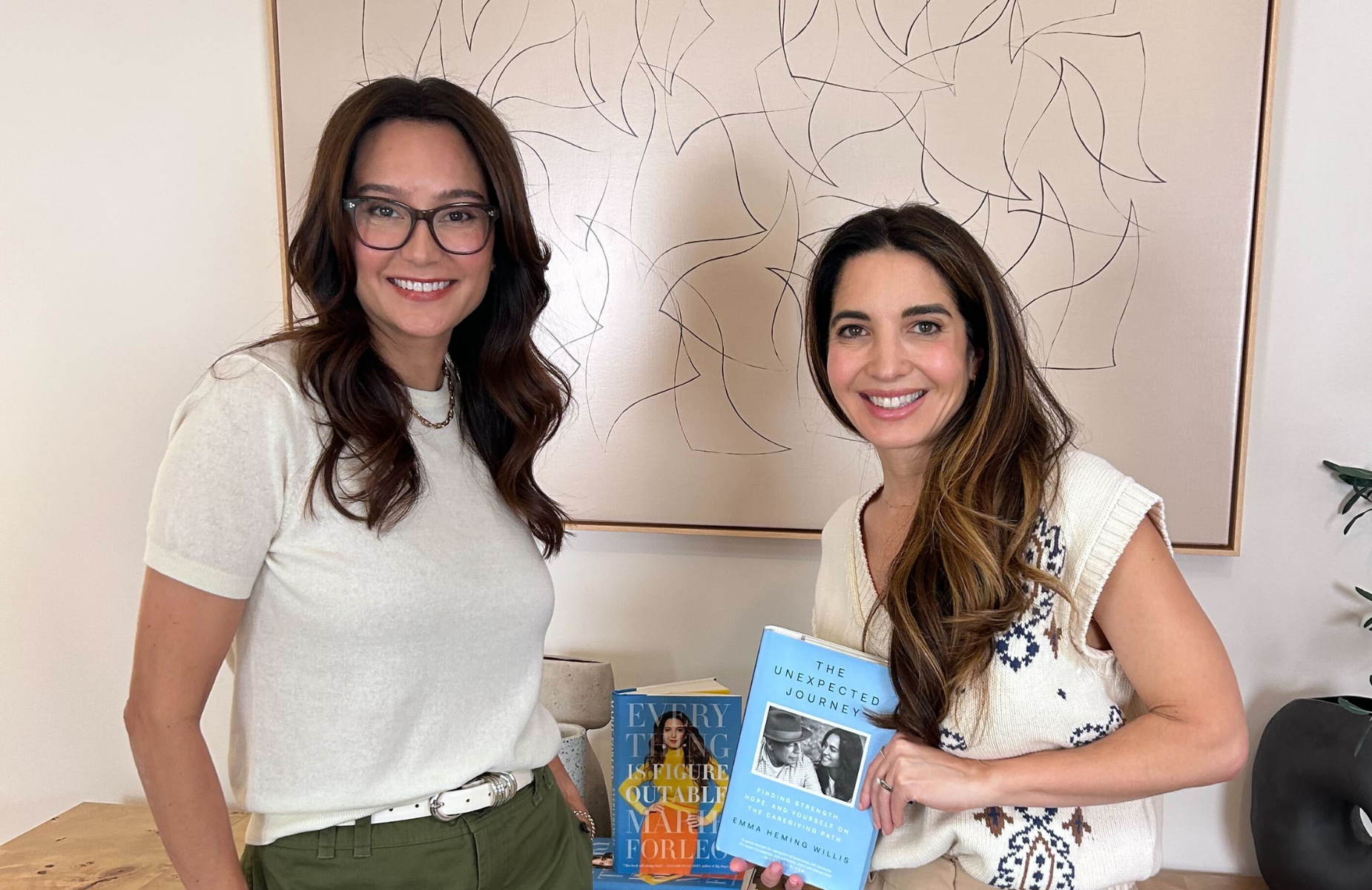
If you've ever caught yourself thinking, "I don't feel like myself anymore" — you're not alone.
The random tears. Zero tolerance for stress. Brain fog. Complete loss of joy. Something starts to shift around our 40s, and honestly? It can feel like you're losing your damn mind.
On today's MarieTV, I sat down (again!) with my dear friend, Dr. Mindy Pelz — New York Times bestselling author and one of the fiercest voices in women's health — to talk about her most personal transformation yet and the surprising message behind her latest book, Age Like a Girl.
Here's the thing. I've read all the menopause books. Done all the research. Been to every doctor. Spent all the money. (Like, all of it.) And still felt like nothing was working.
But a few weeks ago, I read Mindy's new book on a plane in one sitting. I could not put it down because I felt so seen and so heard in a way I haven't these past few years.
That’s why I’m so excited for you to hear from her in this week’s episode.

We talk about:
- What “hitting the break” in midlife actually feels like (and why you’re not crazy)
- Why so many high-achieving women crash at this stage of life
- The neurochemical crash no one warns us about (dopamine, serotonin, GABA — gone!)
- Why the hormone patch alone might not save you
- How to spot the #1 red flag of perimenopause
- What to do when your old life — and identity — no longer fit
- How to talk to your partner about what you’re going through (yes, men need this info too!)
If you've been silently wondering, "What happened to me?" or "Why can't I hold it all together anymore?" — this conversation will make you feel seen, validated, and deeply empowered.
Listen to this Episode on the Marie Forleo Podcast
Subscribe to The Marie Forleo Podcast


View Transcript
Mindy. I've gone to so many doctors I've met. I've spent so much money, like all the things, and still have felt like, nope. Yeah. Nothing's working. Nothing. So let's start with what you shared specifically at the top of the book, when you experienced your own personal perimenopause journey taking a turn for the worst. Yeah. Yeah. Thank you for all of that.
And you know, I couldn't agree with you more from the lens of. There's so many good books out there. And actually, I don't know if I told you this part. I went into contract on this book three years ago. So, like, it was like. And it was the book completely morphed into something different over time because it was like, unbelievable how the menopause space had changed dramatically.
So, and here's where it changed. We went from not talking about menopause to everybody talking about it, to everybody bitching about it, to, oh, we're suffering because we read the hormone replacements, study wrong, and we just need to get everybody on hormone replacement. And all of a sudden menopause will be easy. Breezy. Yeah. And as you, as you've just pointed out, that is not every woman's experience.
Nope. So for the last ten years, I've been researching this book and trying to answer, what's the purpose of menopause? Because women live % of our life without a whole organ system like that whole organ system shuts down. Yet we carry on. So I knew there had to be a reason. So the first thing I just want to say that I think it's exciting that we're talking about menopause, but I also think we're missing a huge opportunity to look at menopause as what I call our get out of free, get out of jail free card.
And I'll explain. I'll explain why here in a second. So, God, what happened to me as I was writing this book? Was I broke? I completely broke, and, you and I were talking about this this morning, and I had been wondering for years. I'm curious if you have this same, same wonder of, like, what does an official mental breakdown feel like?
Yes. Like, how do I know when I need a dramatic change? And I could feel the stress of life just building and building and building and the things that I noticed is a little bit of what you noticed this morning, which is I became very stress intolerant. I, you any little stressor. And I was like, have these really exaggerated outbreaks.
And I would walk away from these moments with my family, my team, and I'd be like, God, Mindy, you you seem like you're a little bit. You're a little bit over, over the top and how you're reacting to stress. And so I started noticing things like that. And then, September of last year, one of my closest friends passed away.
He was years old. I was in Turkey on my first vacation, which is important to note. I had never taken a three week vacation before, and my best friend said, hey, let's go to Turkey. I've got this really cool trip. We should go on. So off we went, and in the middle of the trip, I get a call that my really dear friend has passed away.
He had a heart attack at He and I ran our practices together. He was like a big brother to me, and I just. I couldn't function. I don't know if you've ever lost somebody like that just randomly at a young age. Yeah, it was actually my college roommate a few years ago. Died in her sleep. Yeah, yeah.
It was around the same time. It was like And for me, that was like, definitely the year, maybe a little bit beforehand when stuff started. Kind of going offline and we were talking about like where the wheels start falling off. Like, it's like, where are the wheels exactly? Yes. And I remember saying, and I love this because this is the part that, I'm really excited to dig into because it's not this shiny like, hey, you're going to get through this, and we're going to talk about all that good stuff, like having navigate this because it isn't all doom and gloom, but I feel like for me personally, I've had the
questions in my mind. I'm like, are all women being gaslit that like, you know what I mean? Like, this is going to be the most powerful part of your life. And it's a big upgrade happening. And like I've read the science, I'm an intelligent human being, but I also know my real lived experience. And anyone who knows me and you know me personally, I have not only no filter, but I also have a really big boss, Peter, you know what I mean?
Where I was going, like, I don't know if the it I'm a marketer. I don't know if I buy it, I don't know if there's a lot of supplements, there's a lot of hormones, there's a lot of money to be made. And really it's like, dude, strap yourself in because it's in downhill. And like, you've got to like, hang on for dear life.
Extreme sport. Yes, it's an extreme sport. So to go back to your question, yes, I've had that experience and I think so many people listening and watching now, I would imagine maybe have a similar experience where the details might be different of the story, but I like to call it because I'm Italian American, a tiramisu of stress.
It's like stacks and stacks and layers and layers of breakdown that all seem to occur at the same time, when your resilience is the lowest you're over, reactivity is the highest. Yeah. Everything inside my message and the thing that I've been trying to communicate out to friends, especially friends who are younger than me, friends of mine who have female partners.
So some of my guy friends who I'm like, oh, I need to tell you something because I know your wife. And then, you know, your girlfriend, your significant other is in her s right now. Let me give you a little preview of what to come if you start hearing from her. I don't feel like myself. That is a big flag.
Do not downplay it and don't gaslight her. Oh, beautiful. So that is so good. You got it. Yeah, I you know, and I love that because we, I put a whole appendix to men in this book. Yeah. Because when I talk about I may read that thing and I remember I texted you, I was like, Mindy, can we have a PDF?
Can I get a QR code? Because, like, this is the kind of information that it comes out of my mouth and it is like a fire dragon. Yeah, yeah, yeah. It might not come this smoothly from you, Tim. For sure. Get back in through that. Yes. Back to your book sound. So you're on your hunt. Quirky friend passes away.
Devastating. Yep. So I, I came home and I actually went into his practice to help his team because we were like, best business buddies. I mean, we all have that business bestie. He was my business bestie. And so I went in there to help. And then I quickly realized I'm not equipped to help. His patients were crying. Everybody was upset, and I'm like, I can't be here.
I can barely breathe right now. So that that kind of lingered for several months, and I finally decided we had rented a house down in LA. I grew up in LA, and I was like, I just want to go to my happy place. I need to like, relax, get away. I told my husband, I'm going to go write this book.
I'm going down to LA. I need a couple months by myself, to write the book. I'm just hanging on by a thread. Great. Let me interrupt you there, because there were a few details that you wrote in your book that I want to verbalize because, again, I was like, oh, my friend Mindy, have you been looking in on me or are you looking?
I don't know, are you like, did you bug my phone? So some of the things that you mentioned, your behavior became unrecognizable. Negative thought loops. Yep. Constant irritability, random crying, total loss of joy. This is big. Yeah. Couldn't focus like you used to. Couldn't work a full day. Felt like the battery in your brain had died. Your lifelong optimism.
Hi. This is why I sentence flipped into worst case scenario thinking. You talked about this panic and irritability over very small stressors and the can do version of yourself disappeared, forcing you to cut your workload in half just to function. There's all this tracking. Oh, absolutely. I mean, it sounds like a track to you, too. And I think a lot of women, that's why I want to talk about this.
Yeah. Like at some point you're like, I can't do this anymore. And then you kind of ask yourself, what is this? What is this thing I'm doing? I created this life. Yes. And I kept saying to myself, and I've been saying to, you know, dear friends, and I've talked about this on the show before, but I never had someone who we could, like dive deep into this.
The, the narrative that I think has been so harmful for me personally has been, what's wrong with me? Right? Right. What's broken in me? What has happened to the me that I have known my entire life? The me that I've loved, the me that I've relied on, the me that I can count on to literally be superwoman. And I was like, where the hell did that go?
Because I like that and she is not here at all. She has left the building. So I'm going to pause there and go back to you because no one else has talked about this. Yeah, well, you know, I call it the neurochemical armor. One thing I discovered in the research I've been doing on menopause for ten years is that we don't just lose estrogen.
But I put in the book, I love calling it estrogen Girl gang. Like there is a gang of neurochemicals. Dopamine, serotonin. Those kept us motivated and and joyful. Acetylcholine kept our memory in good shape. Gaba calmed us. Oxytocin made us feel connected. Bdnf helped us hold on to new information. When estrogen decides to leave the building, she takes her girls with her.
Yes, and I going to you. We're going to go that we're going to break all that down because that's a little bit further in on my neck. Yeah. I'm going to come back to you telling your beautiful husband who I know and love, like, hey, I need to go. Bye bye for a minute, go to my happy place in LA to write this book.
Yeah. So so that's what I did on that literally on January st of I got on a plane, went down to LA, and I exhaled. And on the morning of January th, I got up. I actually had a gym membership that I had just joined a really nice gym. I was really excited. An appointment that afternoon got on a call with a supplement company that we're looking to create some really cool supplements with, and about halfway through that call, I say to them, something smells like smoke, I need to, I need to go outside and look.
And I walked out into my backyard, and the whole neighborhood was being covered with smoke, and my whole backyard canyon was on fire. And I go on to the street. Now, the thing to know that's really important, that relates to every single woman is that at that day, I was evacuating at nine. I was supposed to lead people through a three day water fast.
I'm literally evacuating my neighborhood. That's burning. I'm in traffic on Sunset Boulevard with embers everywhere, and I call my husband, and I said I might be a little late. I just need to find a parking lot. And as soon as I get to a parking lot, I'll pull my phone up and I can. I can lead the group.
And he was like, honey, you need to get safe. So I get out of this, out of the I didn't make the call. I go to another hotel, to a hotel, and within a couple of hours, I get evacuated from that other hotel because the fire goes there. I finally ended up the next day, you know. Lisa, you.
Yeah. I end up at her house and were there that night. And the Hollywood Hills goes on fire, and now I have to evacuate. We all have to evacuate from there. So three evacuations in about hours. And, I didn't know how to function. Thank God for Lisa. My. I felt like somebody had taken advice. And this is the important part that I want to point out, is what does it feel like when you've hit the break?
Yes. I felt like somebody had a vise on my lungs and my side, and I was like breathing really shallow. I couldn't find a positive thought. I thought my whole world had ended. I couldn't figure out what to do. I was like a little toddler that didn't know how to take the next step. Yeah, and thank God for Lisa and Tom because we were, you know, Tom especially sort of guided us all through getting through the third evacuation.
And, you know, the important part of this story was the next day, I had to lead the group again through a water fast. And so what I decided to do, Marie. And this is what I want every woman to know, is I got on that call. We actually have it now on YouTube, on my YouTube channel. And I basically said, you know what?
I can't do this anymore to people. I was like, I'm not okay, and I can't do this anymore. And one of the things I did say, and I think this is really important, is I said, I'm not okay, but I'm going to find, okay. And so for the next three days, as we waited to hear if the house survived and our stuff survived, I literally did the most freeing thing I think every woman should do when they hit this point.
I called my kids, I called my parents, I called my friends, I went publicly on my socials, and I was like, thank you for everybody's concern. I'm not okay. I'm not laughing because it's funny. I'm laughing because it's the laugh of recognition of myself saying, I'm not okay, and I need y'all to know it mazing. Yes, incredibly amazing and incredibly freeing.
And I know this was so painful and I know it's traumatic and you know what I mean. But this is why I wanted to have this conversation, because so many in our audience right now, it doesn't matter if you have a public persona or not, because so many high achieving women in their lives, regardless of what is front facing, are the heroes, are the glue.
Are the superwomen who everyone in their immediate circle, their career, their larger community looks to, and they look at themselves to. I have it together. I can figure this out. You know, obviously I'm the one that wrote that damn book, which I still do hold to be the kids like it is. I will never let go of that because it has been a lifeline.
Yeah, when there has been such depths of despair. But our starting point has to be honesty when we are not okay. Yeah. And it's especially important to talk about this because this is often the conversation, especially more broadly around midlife and the biochemical changes that we go through that we don't talk enough about. Yeah, no, it's about patches and pills and creams and this and that and all the and all of that is wonderful.
It's important for us to be educated and to know our options and to know what things can help us mitigate. But there's also a big reality where it's often not enough. Whether you got a patch or you got your pills, or you got your exercise, or you got your meditation, or you got your cold plunge again, done all that.
Been to the circus, got the t shirt, have it often. Not enough. It will not necessarily save you from that point of breakdown. From that point of holy. This is too much. I am being swallowed. Yeah, the wheels are coming off. Yeah. I'm not. Okay. And you have to feel safe enough to be able to say that.
Yeah. You know how you know, what was interesting is when I said it on the webinar to these water fasters. Yeah. I said put in the chat. How many of you feel like you're not okay? Oh my God, Marie, like the chat just blew up. I'm not okay, I'm not okay, I'm not okay. Yeah. It was like us, and they were all women on there.
Yeah. And I was like, oh my gosh, so many women are not okay. And I want I want to talk about why I think we're not okay, but it's menopause. That is a mirror. It gives you that mirror for you to finally acknowledge that the way you've been living your life, holding it together in this performative, people pleasing way, is not working for you anymore.
And the day I publicly announced I was not okay was the day I started to heal. It was like I needed to just put down the mask and be like, I'm not okay, this is not working. This life I created mixed with this hormonal mix that's going on in me isn't working for me anymore. And I need to change something.
And I had like you, I done the patches, the creams, the everything. But there was a breaking point of holding my shit together that I couldn't do anymore. And the minute I let go, I it was profound. But I started to heal and I started to put myself first in a new way. Yes. And we're going to dive into all that.
And I want to I want to ask you about this, too, because I've been really thinking a lot about this over these past three years. And I was like, you know, in my personal experience, for me, it was like, oh, everything that I used to care so deeply about everything that was so important to me, like there was genuine passion, you know, everything was genuine.
Agreed. That's the one part where I'm like, oh, what used to be true? What used to be aligned, what used to be an authentic expression of everything that I knew this person to be no longer fits. So one of the other things that I started saying, and I just want to put out these phrases because I feel like it is so incredibly healing, just like I felt so seen when I was reading the pages in your book.
That's what I'm hoping this conversation can do for tens of thousands, if not hundreds of thousands of women out there. I and I was talking about this with like my best friend and some close people as like, I actually feel allergic to the things that I used to love, to the things I was like, I am actually like, I can't do it.
And I am one of the most strong willed people like you. Exactly. You're like, I got grit, I can help, I'm there, I can like at work, I can do it. I was like, nope. Like my body was just like, absolutely not. You cannot no longer fits. And one analogy that has been really working for me is I was like, oh, mission accomplished, meaning mission accomplished on that version, that chapter, that expression of who I have known myself to be.
It is mission accomplished. I'm not that right out of the park. Yeah. And now though, it's like, oh, I am like a plant that has outgrown my container. I ain't ready for the new container yet. That's in the land of the . But that the space in between, this liminal space which we're going to talk about, this is the dark stuff.
This is the obstacle. Space is so hard. It's so hard, especially for overachieving, somewhat perfectionistic. Again, raising my hand there where it's like you're so used to being in control. Yeah. And you've had to fight for that control and you've had to, you know what I mean? Have that for years because it was a sense of safety and it's like, oh, all that's going to fall away.
Yeah. So and I this is why I, you know, you and I align on this is like, this is why I'm troubled by the direction that the menopause conversation is going, because there tends to be this outward facing idea that the suffering has happened because you didn't get the right prescription of hormone replacement. Right. And not every woman is experiencing the benefit of hormone replacement.
And we need to think about what is actually happening to our brains as we go through this. Yes. And what I brought forward in this book after just researching this and this is Lisa Mascagni's work, and I feel like when she put her book, The Menopause Brain Out, it was a beautiful book. But but as I read it and interviewed her, I'm like, there's something deeper going on here.
The brain is rewiring itself for a new version of you to emerge and mix that with this neurochemical shift that's going on. You don't have as as a friend said, you're not drugged on estrogen anymore. Yes. Well, let's talk about that for a minute, because then there was the part in your telling of the story where you said, you know, it came the lowest point, like you were so desperate for help, you were doing all the HRT again, all the things that you've known and you've helped people with for decades now.
Yeah, lifestyle, nutrition, movements, like all the things that we all know to do. Yeah. And there is the lowest point, which is suicidal thoughts like you wrote, if this is what my new menopausal brain was going to be like, I wanted out. And I wanted to say this too, because the past few years for me, I've had so many dark thoughts and I've literally had to tell my friends like, I will not hurt myself, but I've said more times than not, like, I don't want to be here.
Yeah, not do you know what I mean? I'm not planning. Oh yeah. But the feeling, the feeling inside of going like I. That I don't care. Like I just want out again. Just to be really, really explicitly clear. I'm in not no planning stage, but I'm like, these are thoughts and these are feelings that I have never experienced before in this way.
And I think it's so important that you said that because, again, I think there are so many of us who have gone like, wow, how did it get this dark? And I love that you wrote that. It was in that experience and in that honesty that you said, I gotta go deeper. Something's gotta change. This isn't me. Yeah.
So I think you bring up a really good point. What what is not being talked about in the menopause space is suicidal ideation is actually quite popular. Comment, I should say. Yeah, it's a lot of women have that feeling. And there's actually some science showing that there's parts of the brain that get stimulated in this brain rewiring.
Yeah, that leads women to romanticize. I'm out. I'm going to kill myself. And just like you, one of the things that I did is I went to my therapist and I was like, I got to tell you what I'm thinking. Like, I'm not sure I want to be here anymore. And, and we even had a conversation in all honesty, about she said to me, do you have a plan of how you would take yourself out?
And I'm like, I haven't gone that far because I feel like that wouldn't be fair to my family. That wouldn't be fair to a lot of. But I can't live with this brain anymore. And so she, you know, I kept her and I think this is really important is if you are feeling this, you got to tell somebody.
Yes. So that they can keep an eye on you. Because one of the reasons I wrote this book was ten years ago. I saw a statistic that to is the most common decade for a woman to kill herself. And this isn't because she didn't get hormone replacement, right? It's because she is going through a neurochemical shift that is doing exactly what you just said were an old life that once served her and fit her, doesn't fit her anymore.
And now the new life hasn't emerged. She's in that liminal space. I call it like the glue that a caterpillar does when it crawls into the chrysalis. Yeah, it completely dissolves itself so that the butterfly can emerge out of that goo. Yeah, but what we don't talk about is the goo. We always talk about the butterfly, not about the the dissolving of the caterpillar.
Yes. And so I really feel like when we look at how the brain rewires itself, when we look at how the neurochemical armor comes down, really what you're looking at is what parts of you do you like and what parts of you do not serve you on this next journey of life, and that if you dive into it as scary as it can be, is really quite beautiful.
Yeah, that's the space I've been in. Yes. And I want to say this too. It's like when you are feeling these things. For many of us it also happens. It goes back to my little Italian American dessert analogy. It's a tiramisu of stress. Right. So we're talking about this also. So it's like a Venn diagram for so many women.
They're still raising kids. And in my particular case, you know, my stepson is an adult now. He's amazing. Last, however, my parents have been a show and a half for two and a half years. Oh, I got that distress. So like, you know, and I've talked about this very, very publicly. It it has probably been the most hellish, devastating like, fight or flight lock to eat me.
My total nervous system locked in fight or flight to a level that I was like, wow, I know I'm a strong person now. I really know I'm a strong person because to be able to stay in this this long. And so just normalizing for anyone out there who feels like, oh my God, I can't take all of this.
Yeah, you are not alone. There is help, there is hope. But you do not have to feel broken. If you feel broken, you are not. And there are millions of us that feel the same way and that can relate. And you are not weak and this will not last forever. It was so well said. And the parent thing, I don't think we talk enough about now.
I have the same thing. I had to get my parents caregivers as I was going through this, because I couldn't be there to support them. Their behavior is like two toddlers. It's like taking care of two toddlers now. Yeah. It's it's it's quite a load. Yes. And here's something interesting that I think every woman can take.
If you're resonating with this part of the conversation. One of the things my therapist said to me when I was like, I can't do this anymore, like I need to leave this planet is she said, Mindy, what do you want? And I was like, what do you mean? You're like, right? I was like, what do I want? What do I want?
I had I don't know if you resonate with this, Marie, but I had never asked myself, what does Mindy want? Not Mindy the businesswoman, not Doctor Mindy, not Mindy the wife, not Mindy, the mom. But what does Mindy want? And for about a month after the whole fire situation, I actually what I did is isolate myself for four months.
I got an Airbnb here in Santa Cruz by the water, by nature. And I was like, I can't handle anybody. I got caregivers from my parents. I told my husband what I was doing, like, I need to go away so that I can find myself. And every single day I would wake up and I would ask myself, like, do I want breakfast?
I don't really want breakfast. Do I like, do I like cream in my coffee? Or did I put cream in my coffee years ago and decide it? That was the thing I was doing. Do I like I went into like, do I like how I dress? Like, why do I dress the way I dress? Do it? Why do I eat dinner at the time I eat dinner?
Why do I go to bed? What shows do I mean? I literally for four months did an self inquiry into what does Mindy want out of the context of family business or the culture? And it took about four months for me to get that muscle where I'm like, oh, I like this, and I don't like that. Yes. Yeah. Have you ever done that?
Well, I like I'm a pretty social person, you know me and I'm pretty like, you know, I like doing things, whatever. And in the more recent times, like, I just need so much more alone time. And that was the other thing about the book. It was like, oh, I'm in my GU phase. Like I'm in the I'm like very mid GU.
Yeah. And and I like it, you know. And it's been it's been a real interesting experience for me of going who is this new version and being patient and curious enough to let my questions emerge. And I do think that this is a really, it's a useful conversation. And I want everyone to know Mindy and I are not saying that we have the answers, per se.
You know what I mean? You've got a lot more than I do. I will put myself back in the position of, like, do you know, it's like, I believe every woman has the power to figure this out. It is not something that happens overnight, and it requires a tremendous amount of patience. It requires community. It requires, a level of support that you may not have in your life right now, but that you can form.
And it's going to look different for all of us. So back to this question of alone time and questioning. I have been asking myself that, and what's been so cool has been like, wow, my answers are different things that I used to want to watch on television, or the things that I used to be attracted to, or the things that I was so convinced were.
Marie. Yeah, I am discovering day by day I'm like, not anymore. I was like, so who's this? Like, where'd she come from? So it is this continual process of discovery for me. And the more alone time I want more and more of it. Where I want to shift to now is I want to talk about how understanding and having the bravery to call out what is the wheels coming off the breakdown, the feeling absolutely, like all of you is crumbling and imploding, and every part of life is just starting to disintegrate.
I love that what you started to discover deeper in the research around the grandmother hypothesis, the power of the Crone, because I feel like this starts to set the frame where philosophy that can be so helpful, and then we'll dive into the deeper bio neurological changes and the neurotransmitters that are changing. And I want to call out some specific experiences where I was like, wow, I am really losing it.
But in your book, I realized brain science chemistry. Okay. And what makes us chemistry? We're just we're all this chemistry and like, it's all we are. This is the thing. You and I. God bless Josh or I get this man. I'm like, whoa, I don't know how I haven't broken yet. Because I it's like, I am legitimately not the same person that he's known for the past couple decades, and that's been destabilizing.
And this is why it's really important that we open this conversation up with men because they don't understand what we're going through, but they can't understand it till we understand it. Yes. And once we understand it and put language to it, then it becomes easier to invite the men into the conversation. So what what's interesting and what I discovered was that, and this, the grandmother hypothesis was one of my starting points because, the grandmother hypothesis basically says that back in the hunter and gatherer days, when a woman stopped her cycle, she was moved to a different position and within the culture, within the tribe.
And that was a position of of leadership. And when I went and I looked at that, this is literal. And I actually brought Kristen Hawkes, who is the champion. She's an anthropologist and the champion of the grandmother hypothesis. I brought her onto my podcast. She lived with a tribe in Tanzania that still practices this today and these grandmothers.
And I'm not saying everybody has to be a grandmother, but these menopause women get up at every morning as a pack, as a group with other postmenopausal women, and they go out for a seven hour trek every single day to go and forage for food and bring it back to the tribe, because the men are off getting a big animal.
Kill the men only come back with a kill % of the time, which is one day out of So it was the postmenopausal women that were able to feed the infertile women and the children to keep us alive. And the belief around the grandmother hypothesis is that actually we would not, as a species, have evolved if it wasn't for the postmenopausal women.
It's amazing. It's really beautiful. And I will tell you this. First of all, I love that because it's purpose. And I remember reading, I was like, I, I, I've been leading for a long time. I'm gonna let other people lead for a minute. But then I remember differently. Yes, exactly. I will lead different. And I'm also very medu, which I go to mid groups.
I'm giving myself permission to be mid June. And then also let's talk about the power of the Crone, because I loved your own commentary in your writing or as a power of the crone. Like, are you telling me I'm old? Not that there's some bad about old, but let's just be real. And you learned that crone actually means something else.
Yeah. So, so I didn't want to just look at one thing I wanted, so I looked at a I looked at a neuroscientist, an anthropologist, a feminist psychologist that we definitely didn't talk about. And I looked at Clarissa Pink Collar Justice's work on The Power of the Crown. A friend of mine had turned me on. You know, we I think many of us read Women Who Run with the Wolves.
But the the The Power of the Crown is about the what happens at this phase of life. And, my friend said, oh, you should read this book. And I was like, did you just call me old? Like I'm met Crone. She goes, this was like in my early s. She said to me, Mindy, do you know what Crone means?
It means crown. You get to put your crown on now. And when I dove into Clarissa's work, she has something called the life death life cycle. And what I really believe between that and between the brain rewiring that we can talk about here in a moment. And the grandmother hypothesis, I started to see that there is a definite purpose for menopause and the purpose is to kill off the parts of you that you're exhausted with, or to stop doing the things that you did to make everybody else tell you you were worthy, or you were beautiful.
And to lay that all down and to start building a life that is yours % yours, where you tell your truth, where you stand up and protect yourself. You don't need someone else to protect you. You protect it. And you are now a wise elder that has a skill set and a new brain that can actually lead a culture in a new way.
And when I started to see that, I was like, this is not the menopause we're being taught. We have women that when they are depressed or they are rageful, we're being telling them, you didn't get the the estrogen patch. Well, maybe we're rageful because we're tired of putting everybody else's needs ahead of our own, and we've been shoving down our own inner truth.
Maybe we're depressed because we've been doing the things that the patriarch told us will bring us happiness. And guess what? We didn't. It's not bringing us happiness anymore. Like, I don't know about you. The things that bring me happiness now is sitting on the couch with with one of my favorite people and having deep conversations. I care more about that than what my YouTube channel.
What numbers are happening on my YouTube channel? Yeah. So there there is a moment that we're not talking about. We are killing off the woman who did everything for everybody else, and a new version of her is emerging. And instead of freezing our faces with Botox and fillers and taking our gray hairs out of our head so that people don't see us old, what if we had a culture where women were doing what they were doing back in the primal days, and we were looking at these women saying, lead us now.
Now you have wisdom. You've rewired your brain. You're being authentically you. Lead us and show us a way, a different way. Yeah, I, I quote, Desmond Tutu is a big fan. I'm a big fan of his work. And he says, if we want peace in the world, we need to let the women lead. And when we look at the way aging is laid out for women, we are so scared of a wrinkle.
We are so scared of the menopausal belly weight, which I understand is not fun. And there's lots of ways to fix that. But what we need to start to do is see that there's a deeper calling for us to come back home to ourselves, and to start to live the life the way we want to live it.
Let's be honest, even the most passionate, driven people get stuck sometimes. We all have those moments when we lose steam and nothing seems to get done. That's why I made one minute motivators. These quick little audio coaching sessions will help you get re energized and back in the game super fast. Grab the full collection now at Marie for locomotives, or you can just scan the QR code on your screen.
You know what I love to is this you called it.
It's like the brain remodel. So I am a little bit addicted to renovation. So I it's part of my, a part of me that I actually love. And I've done several home renovations. I'm in the middle of one now. And here's the thing that's interesting about it. Renovation projects are, annoying. Yes, frustrating. They're super expensive. They take way longer than most of us want them to take.
However, once they're done, my experience, you're like, oh my God, this is the best thing ever. And I usually have a little bit of amnesia, which is why I do it again. I'm like, how did I get myself into this again? But in terms of our brain remodel, which is what this is, I thought this was really interesting.
Like, this can take up to a decade and that it's a marathon and not a sprint. So, I have to ask you this on this, have how are you feeling about this? Because again, I mentioned this earlier, I've been a little bit skeptical where everyone's like, oh, there's this big upgrade. I'm like, oh, but are you gaslighting me?
Is it really an upgrade? And so I think it's true, but I just want to hear your take on this brain remodel. And then we can kind of go into what is actually happening so that we can start to identify some of these really what can be and what has been for me alarming changes. And so we can understand the brain science and what we can kind of do to help ourselves navigate better through the remodel.
Yeah. So I love looking at what's happening in the brain as a renovation. I think you labeled that really well. So something to know is that when we went through puberty and estrogen came in, she started to excite something in our brain called the corpus callosum. And the corpus callosum is a highway between the right hemisphere and the left hemisphere.
And women have a bigger corpus callosum. So once estrogen came in, we started to have what they call a relational brain, meaning every single decision was made through the right hemisphere and the left hemisphere. And so we brought every everything we were doing was like based off of is that okay for that person? Does that work here? And then we can also had our logical side like I'm going to, you know, run a really killer business.
But we brought both hemispheres and we were always thinking about everybody else in our decisions where we're whether we're aware of it or not. When you go into menopause with the lack of of estrogen, and even if you're taking a patch or a pill, you're still have less estrogen than you had at You stop going from a cross referenced relational brain to more of a lateralized brain, where when you are making decisions, you're either sitting in your right hemisphere or you're sitting in your left hemisphere, but you're not operating from both a little more like a man.
So all of a sudden, the people pleasing you don't care about it anymore. You literally are not neuro chemically addicted to people pleasing anymore. So the remodel project is you are your neurons in your brain, the neurons that are that you needed to keep yourself hooked into the patriarchal desire of what a woman should be doing. Those neurons go away, and all of a sudden the neurons of independence and leadership and and focus like one of the things I discovered is that women are supposed to get with this remodeling of the brain.
Women are supposed to get more focus, better cognition, more confidence, which is not what's happening. So but our brains are geared more towards a lateralized brain where we can sit and connect, and then we can drop that and we can come over and focus on a business task, but we don't bring both of them together for every decision.
Interesting. So when you're saying that's not what's happening, is it that in the remodel, because it was like I will say for me, my ability to focus, which used to be like I have ADHD. So that's I've always been like like that. However, for I think it's for things that I no longer have a tolerance for. So this might be a little bit of a clue.
You know, things where I'm not interested anymore. I'm like, can't focus, can't do it, can't sit there. But if there's something I'm interested in and I'm genuinely passionate about, I could probably go for hours. Yes. Yeah. That. Yeah. So yeah. Yeah. Because our focus gets even better. Yeah. Because so because the lateralized plane. Now the remodel. Let's go back to what you're experiencing.
When you remodel a house, you're in the middle of messy. So if you're, you know, hearing this and you're like, I don't feel my brain doing that. Yes. What I wanted to bring forward in that is this is why it's like a remodel project. The brain is pruning away neurons that you no longer need, so that you can create new neurons that are going to serve you in the next phase of your life.
And this was Lisa mosconi work. She talked about three times in a woman's life that the brain remodels itself, and it does that. So it could prepare a woman because we're so brilliantly designed. I want to point out it can prepare a woman for the next phase of her life. So in puberty, a teenager, when her hormones come, come.
It's in the neurons that kept her attached to mom and dad. Those neurons go away and new independent neurons show up because with a period comes the possibility of pregnancy. So she needs to detach from needing a caregiver and become her own caregiver. So with the influx of nerve hormones, the brain knows to change itself, to prepare itself for that possibility.
Women who are pregnant when they when the hormones drop after the baby is born, the brain prunes away the neurons. It told you where your keys were, that told you where your task list was, what to do so that you could build new neurons to become highly instinctual and intuitive because your baby doesn't talk. And so you need to be able to read the clues of your baby.
So the brain re patterns itself to be able to match the next job at hand in menopause. You are not meant to people please anymore. You are not meant to do everything for everybody else and get your worth outside of you, because the brain is remodeling itself and those neurons that kept you addicted to people pleasing, they're out there going away, and the new neurons that are forming are ones that let you build life on your terms.
Look at look at the gray. Divorce is so popular right now. It's like every where. Yes, all I see in that is a woman all of a sudden said, wait a second, I want to do it this way. And and her husband was. Or if it's the same sex, you know, spouse basically is like, we don't we haven't been doing it that way.
Yeah. They're going on separate paths. They're like, oh, this is no longer, what we want to do together. And it doesn't necessarily have to be a terrible. Yeah. Yes. Right. And you're a, you're, you're you know, we were talking this morning about, the conversation I had with my publisher this morning with two weeks out from the book, I'm like, I will do it this way.
I won't do it this way anymore. Now, that's a postmenopausal brain that has clarity for I know what I'm doing now is living a life for me. I'm not living a life for children. I'm not living a life for book sales. I'm not living a life for revenue coming in for my business. I'm every day living a life that I feel is authentic to me.
And that's how we're designed. So when we look at women killing themselves, when we look at divorces that are happening, what's happening is that woman's waking up. Yeah. And everybody relied on her to be a certain way, but her brain doesn't work like that anymore. She's met. She's geared to to lead, lead her church lead, lead a community lead her friends.
What she's meant to lead in a new way. Yes. And part of leadership. And I know you've done a ton on this. The most important part of leadership is that you know how to lead yourself first, right? Yes, %. And it's it's so it can be so disorienting. So disorienting. And if again, so for many of us, I'm so curious about the brain.
I've always been wanting to take care of it. And I want to talk about what happens once this estrogen starts to decline again. Doesn't matter if you are in your late s, you're in your s, you're in your s. Everyone has a different timeline. Yep. And it doesn't matter whether you own a patch or you're not on the you know, you're eating all the right foods, all that stuff.
So this was interesting for me. So when estrogen starts to decline, dopamine drops. So if anyone's feeling like, oh my God, why don't I care about anything, why don't I have the drive that I used to drive? It's also if I'm understanding what you wrote correctly, it's also can drive cravings. Like if you're wanting more sweets. If you're feeling like I need a little bit more wine, I need a little bit of more comfort foods.
And also a sense of emotional flatness. That was the thing where I was like, I've always known myself to be at least previous me, right? Super big hearted, super warm. And I am that way still to a certain degree, but not nearly as much. And there have been times where I was like, wow, am I cold hearted. But like it's been a little bit scary.
But then when I read this about dopamine, I was like, oh, this makes sense. So a lot of women listening right now can feel like they're losing their edge. Can you talk us through what's actually happening biochemically? The big missing chemical of dopamine. And if there's anything that we can do to help us navigate this time, like do we want to boost it, just walk us through what?
That. Yeah. So the interesting thing about estrogen that I found along my research is that she doesn't act a lot like, well, you know, she's the diva of all hormones for sure. But let's, let's let's think about Beyonce. Like, Beyonce doesn't get on a stage by herself and be that spectacular. She's got a group of people. And so that's what estrogen also has a group of neurochemicals.
So whenever, whenever, whenever estrogen kicks in she brought one of the chemicals she brought was dopamine. And so dopamine is your motivation. Dopamine is the thing that gets you the drive gets you up and out of bed to go do something. But when estrogen leaves, dopamine goes with her. I think of it like, do you remember in high school when the popular girls sat at the lunch table and she had all her little posse of girls around her, and then she was like, come on, ladies.
Yeah, let's go.
That's what estrogen does. She's like, I'm out. Dopamine. Serotonin. See to calling oxytocin. All these members of the girl gang. You are all on your own now. Now that part is really important because these neurochemicals, we're used to being led by estrogen and all of a sudden you're flat, you're depressed. You can't remember when oxytocin is one of the girl gang.
All of a sudden you don't feel like connecting with people anymore. You can't even people you like. No, right. Like you just are like. I mean, I even noticed it with my children. It was like, you know, I've been dealing with you all for years. Like, you can handle this on your own. You're fine, you're good, you're fine.
Exactly. But it was, like, shocking to not have that motherly, nurturing instinct with them anymore. That's because oxytocin went down. So the big part I wanted to bring forward in, in part two about estrogens Girl Gang is one. I wanted women to understand the motivation isn't the lack of motivation isn't because you are lazy and the the sadness you might be feeling, is could be because you're just low in serotonin and you need a little more.
But it doesn't mean you go rushing out to get an antidepressant and you're not losing your memory. You just all of a sudden acetylcholine started to become at jeopardy, and you didn't have the neurochemical that helped you reach into the hippocampus, where the memories are stored, to pull out old memories. So what's really cool is you get to do your own lifestyle tricks to bring these neurochemicals back.
So for example, dopamine, dopamine loves novelty. Well, what happens when we get to this phase? We're like eating the same foods, living in the same house, driving the same way, wearing the same clothes. If you want to get excited again, change your routine. Change the way you look. Get a new haircut. Start a new sport. I'll tell you what I did.
Just four months ago. I'm living in Santa Cruz, and I started learning how to surf. Yes, I was like, I know. I was like, why can't? Of course I can learn to do that now. And now I'm like, next year. I'm keep thinking of all the new things I want to learn. I'm like, I always wanted to be a really good artist.
I was like, well, why don't I take a class? Oh, you make it with me, I paint, let's work. Yes, we're going to do this year. In fact, I think we'll take well, let's take ourselves to Italy to do it. Why not? I like it, okay, but that's even better. That's my point. Is that routine and and and grinding it in the same way can't you can't do it because dopamine left when estrogen left.
And so you've got a kind of coerced dopamine back. Yes. And that doesn't mean you go on your phone more. It means you go and start to put yourself in new environments that feel novel, that kind of wake you up and get that dopamine going again. So serotonin is not a hard one to get. You have serotonin receptor sites in your eyes so that when you see the midday light, your brilliant brain actually turns light into serotonin.
I how do we get out and go for a walk in the middle of the day without our sunglasses on? To be able to get that the the receptors in our eyes to be stimulated so it can turn into serotonin. We acetylcholine. This is I found this from, from the, grandmother hypothesis. One of the ways we stimulate acetylcholine is by storytelling.
Well I don't know if you have this experience, but my mom likes to tell the same story over and over and over again and acts like we never heard it. Do you have a mom like that. My dad because there's other issues but yes. Yeah absolutely. But once I understood that going back into the memory bank to actually tell an old memory stimulates this acetylcholine, I started asking my parents different questions when they would tell the same story.
I'd be like, you know, you told me that before. What about this part of the story? To try to get them to exercise, releasing acetylcholine. So, so what I did with the Girl Gang is I was like, there are things we can do every single day to bring these neurochemicals back into our brain. We are not a victim of this once you understand the whole neurochemical landscape.
Yeah, and I love that. And just for everyone again, get your hands, get your paws on this book immediately. Like every woman needs to read this. And men, because there's so much science and so many different things, it's like a grab bag of you can be able to choose what you want and what really works for you.
I want to talk about something else that was really validating for me. Was about noise sensitivity. So I'm here in New York City. I've lived in New York City my most of my adult life. I love New York. I'm not going anywhere. I spend more time at a new York now because from an energetic nervous system perspective, I need a lot of resetting.
But this started happening a few years ago, and it was so strange for me where my level of audio sensitivity has gone off the charts, where things that never used to bother me. I'm like, if I hear that sound one more time, like things are going to burn down. I mean, people are going to be singed. It's like Medusa, you will turn into ashes and just crumble.
So what is it neurologically that's happening? Because I feel like that was in there. Is it tied to Gaba? Yeah, yeah, it's part of it is we don't have enough Gaba, you know. So because you know estrogen and progesterone stimulates Gaba. So when those twos start to decline we don't we don't have enough to calm us. But you know with you can do breathing exercises and tricks to bring Gaba back again.
I map that out. But to your point, this this is one that I haven't talked about and I think is really interesting. In my research, I found that a woman's nervous system becomes highly sensitive as she goes through menopause. And I actually have a theory on this. If we go back to the grandmother hypothesis, the protective men and I know this sounds really you know, sexist, but the the men were off trying to get an animal kill.
And so who was protecting the pregnant woman, the nursing woman and the little children? That was the grandmother. And in that protection, she had to have a highly sensitive nervous system to be able to tell if there was a threat, like a tiger that was coming to get her her, the the women and the children that she was protecting.
So I actually think we are meant to be more intuitive. We are meant to. Our nervous system is more sensitive. Like, I don't know if you've experienced this, but I can walk into a room now and be like, nope, this isn't right for me %. I can meet a person right off the bat, and I don't even want to have another word with that person past.
Hello, there's some vibe there. I have become so sensitive and I found something called environmental psychology, where there actually is science showing that are environment has a tremendous impact on our nervous system. And for me, one of those things was my own home. Was that home where every kid hung out at. I loved that until I went through menopause.
Yes. Then I was like, I can't take the mess. I can't take the noise. Why? Why do I have grown men sleeping on my couch? Like, what is going on here? I'm laughing because literally, I have outgrown so many parts of my previous life that I'm like, what? Like it's a WTF all over the place. Yeah, and the craving of more space, the needing of it, I and I actually I said this to Josh, it's so funny that you're saying this.
It was maybe like a month or so ago. I said, Jim, I said, I need to put this on notice. Like, this needs to go on the record that there are X, Y, and Z things that literally my nervous system like I will crumble, it will like, yeah, it's not going to be able to last much longer. And I've started making moves and I'm like, oh my God, this is not me just being crazy or whatever it was like, I can feel.
And I also think, to build on your grandmother hypothesis, you know, one of the things that I've been really spending a lot of time thinking about and feeling into is I was like the intuition and consciousness upgrade that feels like it's happening right now. For me personally, it's like, oh, all of these new capabilities and awarenesses are being developed in this remodel, and that extra sensitivity and that extra level of wisdom and awareness feels really new and really important and like it needs to be protected.
It needs to be sacred. It needs me to care for it in a way that I previously. It was like caring for the business, caring for everyone else, caring for a mission. Lalalala. It's like again, all that's been beautiful and great, but it's like I'm done with that. Mission accomplished. It's off to here now. So so thank you for for saying that I can I say one thing on I call them baby neurons.
I started to think, okay, if the old grumpy neurons or the old people pleasing neurons or the old neurons that told me that I was worthy when I looked a certain way when I was a certain size? If I put a certain thing just. Yeah, those neurons are going away. Yeah. Which is the disorientation for overachieving women.
Yes. Is really real in that moment. But then these new baby neurons. And so I used to think of them like little babies. And when I walked into an environment and they're like, wow, we don't like it here. I'm like, okay, okay, I hear you, I hear you. And so I really started looking at like, I started looking at people I hang out with.
Yes, I looked at TV shows, I was watching books, I was reading what I was scrolling on social media. Yeah. And I kept asking myself, do you want your baby neurons to take on those beliefs I love? And I'm like, no. I really started to think of like, I had a neuron nursery. Yeah, going on. I it's so fun.
First of all, we could talk about so much more about I'm going to say this. And again, I read a lot of books. Y'all. Y'all know this is what part of what I do for a living. And I only have people on the show that I love, believe in, think, have something amazing to offer. And Mindy, like, this is why I wanted to do this so bad.
Just so you guys know, Mindy and I were like, we really wanted to do this in person, but between both of our travel, we just we couldn't make it happen. And I was like, I don't care. I want to do it virtually. Like I need women to get this book, especially when it launches, because we're here in the holiday season, when this is coming out and I'm like, you know, if you have time on a plane or you can just steal away or you can be on a couch just reading for a little bit.
Get this on your reading list. Because if it's anything like me, like when I was in a hotel room by myself, literally, Mindy, I need to say this to you like I reread some parts. Just because it was the you were like the voice that I've needed because I was like, God, I felt like a crazy person and I'm being a crazy person.
I've been a crazy person my whole life and there's been a whole new flavor that I was like, I'm very unfamiliar with who this is. I have a couple more questions before we wrap up and let you go. So if you could go back to the woman you were during break down right when the wheels were coming off, what would you tell her now?
Well, she did exactly what she needed to do, and what I would tell her is you're the most important person in your life. Do whatever you need to do to get your feet back on the ground and really take amazing care of you. Like, I don't know if you've ever heard of that haven thing where you hug yourself and you sort of rub your arms.
Like, I started a routine where every night I would put on soft music and soft lights, and I would have a date with myself. Yeah, and I would. I would just start to, like, hug myself and and be like, I love you, I'm here for you and you get to do it your way now. And that continual it was like a pep talk I gave myself every single day.
So that, that I think the biggest thing I didn't see right, like the weeks after the fire, the brain was doing oh my God our life is over. Oh my God, I can't even function within my marriage anymore. And what I started to really do is bet on myself and I go back to the I'm not okay, but I will get myself okay.
Became my guiding light and every day I just looked at it as an opportunity to come back home to me. I also surrounded myself with some amazing women that one of the things they did the greatest thing. These were women that were five, ten years older than me, that had been through the process. And there were some key phrases that they said to me.
And one of them that really hit was a friend said, Mindy, this is your initiation. I can't tell you what to do, but what I can do is stand next to you and shine a light on your next step. And I can walk that next step with you. But you need to decide how you're going to initiate yourself into this new, new version of you.
I love that, I love that so much, and I think I always get so grateful. I'm so happy to have, friends. I count you as one of them. And folks in my life who are, you know, decades younger than me and decades older than me and in the same realm, because it's like we need to talk with each other.
We need to share that. And, you know, part of what's driven so much of my career is anytime I learn anything that I find to be enlightening, useful, helpful in any sense, I'm like, oh my God, you know, from Jersey, it's like, if I find the best gelato, I'm going to scream about it from a rooftop. You know, things.
It's like, oh my God, I got to tell everyone. And that's why I really wanted to have this conversation. So another question for you is for the women listening right now who find themselves feeling flat or overwhelmed or just totally unlike themselves. What do you feel is one thing they could do today that would help? The first thing is get to know yourself.
It's time to get to know yourself and decide how you want to show up in life. And so when you go, I think one of the things we do is we outsource happiness. And so everything we're doing is looking outside of us for the answers. And menopause is the moment you get to look inside for the answers. That's where the answers are now.
They're not outside, but what a lot of women do is that, like me, they just go blank because they've never looked inside and really asked themselves, what is it that I want? Or how do I want to live? How do I want to show up? That's the opportunity. That's the gift of menopause is that's when you say, hey, I'm really, you know, I can't do the gaslighting.
Yeah, well, getting to know yourself is not easy. Yes. Especially getting this new version right. It's like the dancer might be new and they might be surprising, and they might be disorienting, and it might be there's nothing you have ever recognized in yourself before. And I would say from my end that you don't have to rush any decisions.
That's actually and a super saver for me. You know, there's a part of my personality that is so action oriented and so like, let's get this done and let's make that happen. And I'm grateful. I don't think that part will ever go away. But I've saved myself from not making rash decisions. And when there's especially a new part of my personality or a new part of that, answering of the question, what do I want when it feels pretty radical, or when it feels really different that I don't have to action on it just to know honest, to sit with it, be with it over a little bit of time to see if it sticks to
that question. Just so in full transparency. Yeah, I asked it multiple times a day for a month. Yeah, with no answer. And I was like, well, I used to eat it this time. I dress this way like it's all the micro questions. It's not the big things. But once I nailed the micro things, the things I do every single day, then I started to get some momentum as to, oh, okay, I like it this way.
Even work now. I've gone to the big things, you know, like how much work do I want to do? You know, like, that's a real question I keep. And in what way do I want to do it? Like full transparency. I'm pretty tired with social media and all the highlight reels that everybody puts out. Like, I don't want to be a part of that.
I want to be in a room with women going deep and talking about their own life journey and how they reinvented themselves. I'm way more interested in that than putting up a reel and having everybody go, you're amazing. I don't really care what everybody thinks of me anymore. Truth, truth truth truth. No. Are you for obviously, you know, I'm going to be texting you being like, so about our art classes and like, that's your every sign me up.
But so, so okay, so this is a good point because I think you would resonate with this. Yeah. The year old Mindy or the year old Mindy would have said, I love that, Marie, but I gotta work. Yeah, but the year old Mindy is like, let's get that on the calendar first for next year. Yes.
So that we make that a priority. And this is what I really think women are doing in this journey is they're starting to reprioritize themselves, but they're sort of at a loss of how to do that. Yeah. Which is why they're leaving marriages, they're leaving careers. They're in the disorientation is because, no, we don't have a culture that asks women, how do you want to be?
We have a culture that says, you should be this way. And so from an early childhood we've been told, be this, don't be that. And I think a lot about when we have when a girl goes through puberty and all of a sudden starts pushing her family away, which is very, very common. We give her grace, we go, oh, yeah, okay.
She's going through puberty. She's getting more independent, but we don't do the same for menopausal women. Yeah, we don't go, oh, she's just shedding old identities and she's just becoming a different person. Instead, we are saying, oh my God, all these women are leaving their marriages, and all these women are are all of a sudden doing a new behavior.
And we don't understand what that is. So we better put a patch on them, give them some antidepressants so they don't show up in their truest, most authentic self. Because what the world doesn't want is a bunch a billion women over a billion women are in menopause right now. Imagine if we all spoke our truth. We'd be living in a very different world.
Amen. Sister, I love you. Thank you so much. Thank you for writing this book. Thank you for sharing. So honestly. I know especially, you know, for those of us who do things and you are leading companies or communities or you have any kind of public presence, oftentimes, again, it's been cultural conditioning that be like, no, I'm okay, I'm fine and get everything under control.
And it's like, no, that's why it's just it's because it's bullshit. It's just it's not true. So thank you for this book for everyone listening. Thank you for spending your time with us today. Again, there is so much science. There are so many practical tools. There is wonderful, wonderful, wonderful things that are actionable, simple. So many of it.
It's free all. But yes, so many of the things that you can do to support yourself is free. But this conversation was so healing. So, Mindy, thank you for being with us. I really I love you and I appreciate you. Yeah. Thank you. And again, I think each one of us that takes the mask off and puts it down and says, I'm not okay, but I'm going to be okay.
Yes. Like that's the key part. I think each one of us that says that we free hundreds of women, and I really have a vision of like, what a world would be like if menopause was this refinement and this this ability for a woman to finally do it on her terms. And if what would happen if the whole culture cheered her on, what would that experience be like?
That's my right now. Exactly. Starts right now. Hey, if you love this video, you need to watch this one next. Trust me on that.
If this conversation resonated with you, I highly recommend checking out Dr. Mindy's book Age Like a Girl. Her research is impeccable, her honesty is refreshing, and her mission is to help women stop suffering in silence and start thriving in the second half of life.
Because aging like a girl doesn't mean shrinking or fading or disappearing.
It means rising.
Wiser. Stronger. More unapologetically YOU.
You deserve that. We all do.
XO
 View Comments